Uncategorized

The Joy of Reading Lady Susan

Michele Larrow

There is something truly breath-taking about reading Jane Austen’s novel-in-letters Lady Susan.  Most scholars believe that she wrote it before she turned twenty.  In the Oxford Edition of the Minor Works, Brian Southam hypothesizes that it was written between 1793-94 (MW, 243).  Because it is a novel in letters, we get to see how characters portray themselves to different letter recipients and then how they are perceived by others who write letters.  So the main dynamic of point-of-view is between Lady Susan and her sister-in-law Mrs. Vernon.  According to Juliet McMaster (2016) in Jane Austen, Young Author, “‘Lady Susan’ features a totally self-seeking female protagonist whose considerable power lies in her freedom from moral scruple” (12).  The language of the letters and the variations on perspective are a pleasure to read.

You can see the dueling perspectives of Lady Susan and Mrs. Vernon in the following quotations.  First, Lady Susan being candid with her confidante:

“There is exquisite pleasure in subduing an insolent spirit, in making a person pre-determined to dislike, acknowledge one’s superiority.” Lady Susan, Jane Austen Letter 7, Lady Susan to Mrs. Johnson (about Mr. De Courcy) Minor Works, 254

Next, Mrs. Catherine Vernon portraying her view of Lady Susan in a letter to her brother:

“[Lady Susan] is clever & agreable, has all that knowledge of the world which makes conversation easy, & talks very well, with a happy command of Language, which is too often used I beleive to make Black appear White.”
Lady Susan, Jane Austen  Letter 6, Mrs. Vernon to Mr. De Courcy, Minor Works, 251 (spelling and capitalization from MW)

The male characters are rarely given a voice in their own letters, with the exception of Reginald De Courcy, who has a few to Lady Susan and one to his father.  Juliet McMaster calls him “a bag of goods contested over by the women” (Jane Austen, Young Author, 12).  In a reversal of the reality of the time, the men are portrayed as dominated by the women (McMaster, 12).

Lady Susan is such a fun read.  If you have never read it, I encourage you do so.  You can download a free copy through Project Gutenberg:  http://www.gutenberg.org/ebooks/946

I think the quotation in the header of this article, “Facts are such horrid things,” is remarkably post-modern.  And I must close with another favorite quotation from the work, that shows that underneath it all, Lady Susan wants something else besides money:

ldysusanrichesonly
Fun, Uncategorized

Holiday Cooking

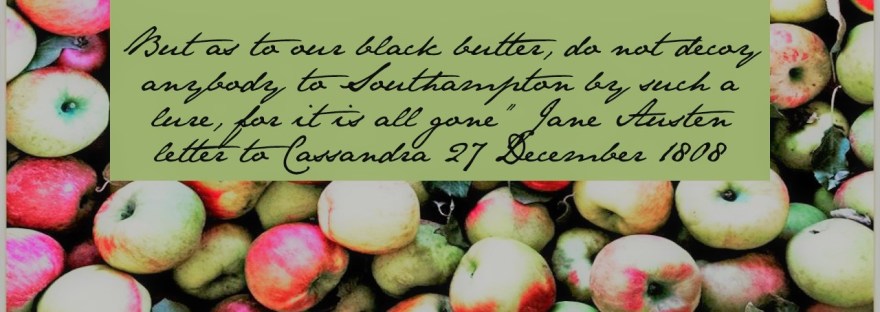
Our new treasurer, Cassandra Bates, enjoys Regency cooking.  Here is her blog post about black butter:

Shortly after Christmas, Jane Austen wrote her sister, Cassandra, about an evening party at her brother’s house in Southampton:

“The last hour, spent in yawning and shivering in a wide circle round the fire, was dull enough, but the tray had admirable success. The widgeon and the preserved ginger were as delicious as one could wish. But as to our black butter, do not decoy anybody to Southampton by such a lure, for it is all gone. The first pot was opened when Frank and Mary were here and proved not at all what it ought to be; it was neither solid nor entirely sweet, and on seeing it Eliza remembered that Miss Austen had said she did not think it had been boiled enough. It was made, you know, when we were absent. Such being the event of the first pot, I would not save the second, and we therefore ate it in unpretending privacy; and though not what it ought to be, part of it was very good.“ Jane Austen to Cassandra, December 27, 1808

The Black butter that Jane Austen referenced in her letter to Cassandra is not what one might think (a sauce of blackened butter), but rather a thick, dark conserve of fruit, often apples (much like American Apple Butter). The other is a French style “beurre noir” and is a sauce of brown butter (if it goes black it is ruined, why the name, who knows, French Culinary).

Below is a rather traditional Black Butter similar to the one in Jane Austen’s letter:

Take 4 pounds of full ripe apples, and peel and core them. Meanwhile put into a pan 2 pints of sweet cider, and boil until it reduces by half. Put the apples, chopped small, to the cider. Cook slowly stirring frequently, until the fruit is tender, as you can crush beneath the back of a spoon. Then work the apple through a sieve and return to the pan adding 1lb beaten (granulated) sugar and spices as following, 1 teaspoon clove well ground, 2 teaspoons cinnamon well ground, 1 saltspoon (about ¼ tsp) allspice well ground. Cook over low fire for about ¾ hour, stirring until mixture thickens and turns a rich brown. Pour the butter into small clean jars, and cover with clarified butter when cold. Seal and keep for three months before using. By this time the butter will have turned almost black and have a most delicious flavour. –  Maria Hubert von Staufer March 1995


Uncategorized

A Thousand Thanks

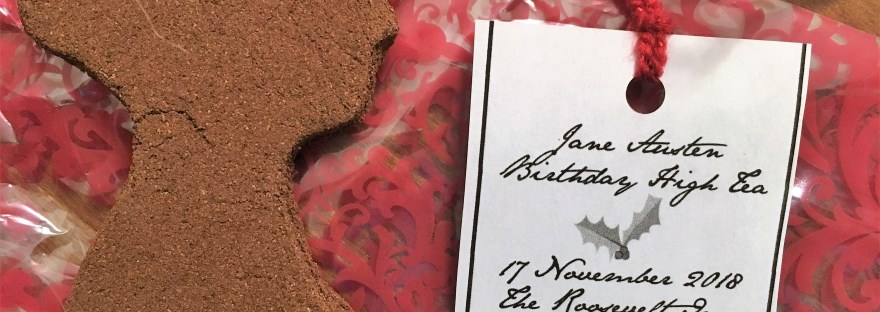
As I reflect on our Jane Austen Birthday Tea, there are so many people to thank. Thanks to the staff at the Roosevelt Inn for the great food and kind service.  Amy Lyons, co-Regional Coordinator, suggested the Roosevelt Inn and coordinated arrangements with them.  Jane Provinsal, our Social Media coordinator, made the lovely cinnamon Jane Austen ornaments/decorations (see the header image).  They smell heavenly.  So many people donated to the door prizes to raise money for our group.  There were basketball tickets; Regency dresses, reticules, and scarves; many books and games; embroidery; and grab bags.  We also had five theme baskets: Tea Time, Lavender Potpourri, Dress Up, Fun and Games, and Book Lover.  Thanks to Pamela Mogen, Cassandra Bates, Nancy Jo Tschida, Brenda Bye, Chuck Pierce, Sara Thompson, Debra Peck, Anne Hollum, Cindy Bell, Michele Larrow, and Yvette Tremblay-Kelly for donations.  We were able to raise over $150 for our group due to the generosity of the gift donors and those who purchased tickets to win the prizes.  (There are many pictures of the tea on the Photos of Past Events page).

A highlight of the tea was our reading of a short play Jane’s Dancers that we got through the script bank that JASNA has for the regions to use.  It was developed by the JASNA, Northern California Region.  Our readers/performers were highly entertaining and the words of Jane Austen about dancing were a fitting way to celebrate her coming birthday.  Thanks to Vickey Bolen, Van Brink, Brenda Bye, Debra Peck, Sara Thompson, and Nancy Jo Tschida for your wonderful rendition of the play.  See below for a few short snippets of the video.  Apologies for the poor stops and starts of the videos.

Thanks to everyone for a great tea.  I am thankful for all our members and everyone who has come to all our events this year!  We appreciate Sheryl DeShields who served as our treasurer for a year but had to resign.  Thanks to Cassandra Bates for agreeing to serve as our new Treasurer.  She was elected unanimously at the meeting portion of the tea.  Michele Larrow, Co-Regional Coordinator

  1. Catherine Morland and Henry Tilney

2. More Catherine and Henry

3. The Narrator from Northanger Abbey

4. Part of a scene from The Watsons

Uncategorized

Using Vintage Handkerchiefs to Decorate a Reticule

Using Vintage Handkerchiefs to Decorate a Reticule by Michele Larrow

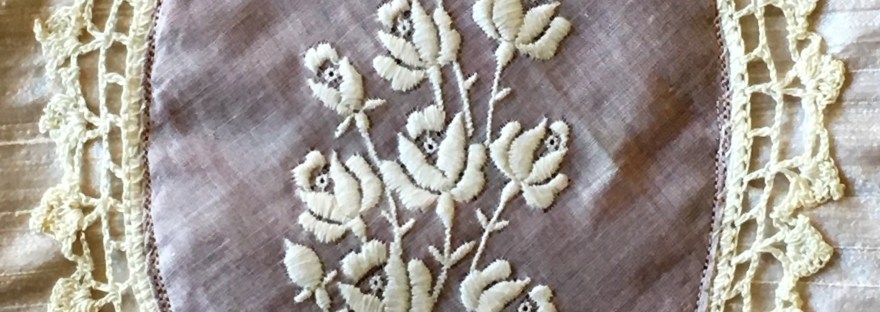
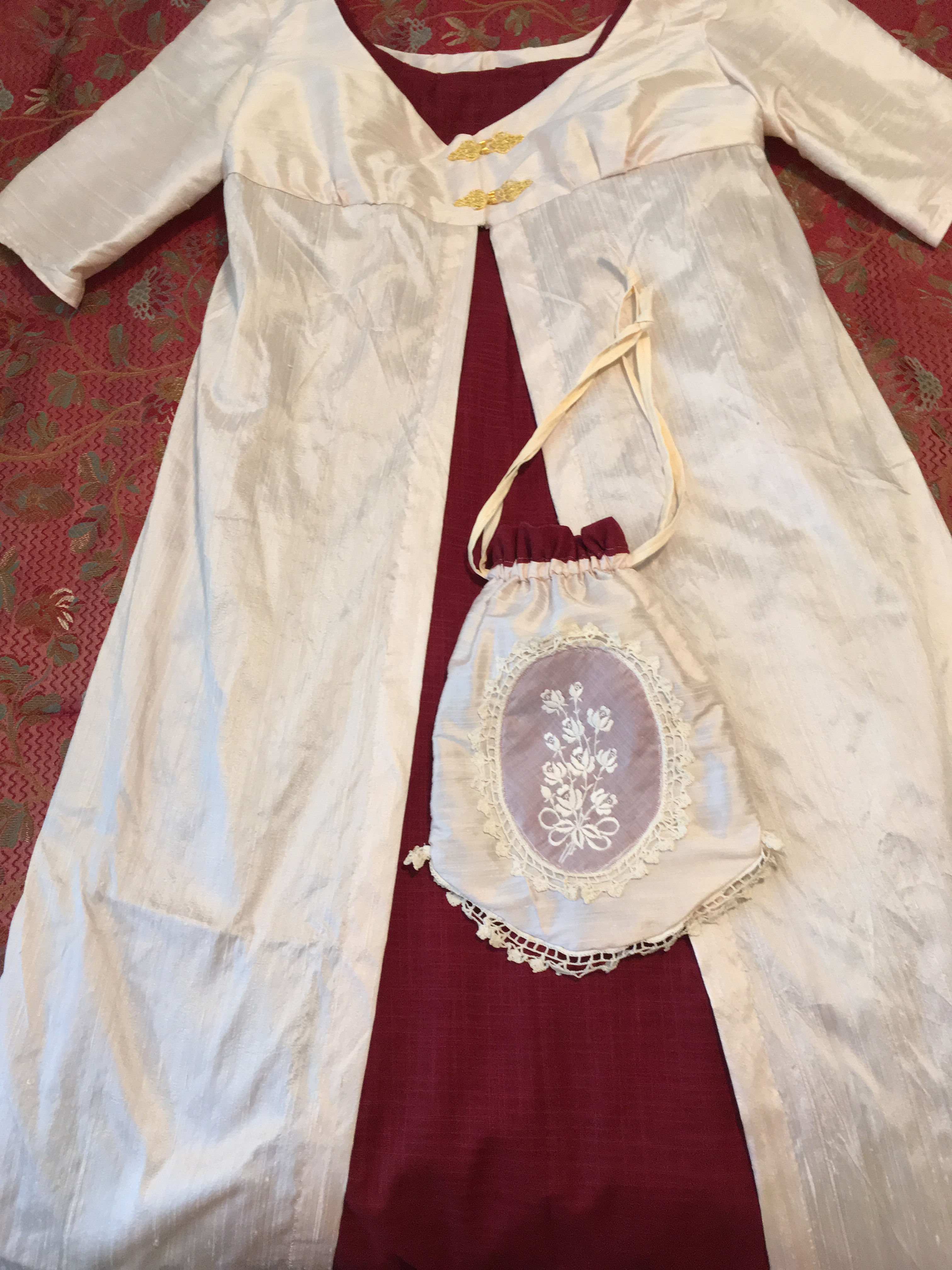
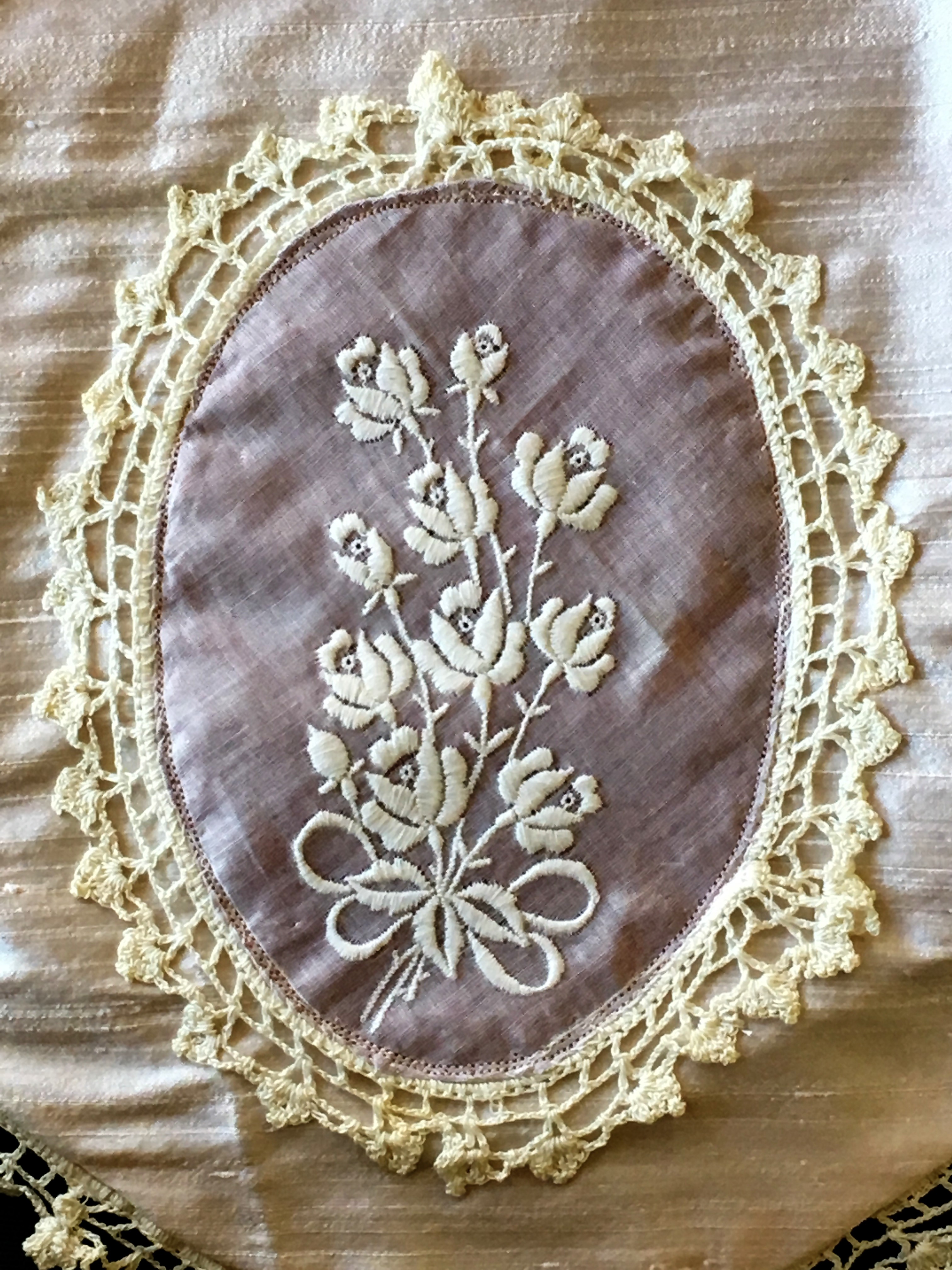
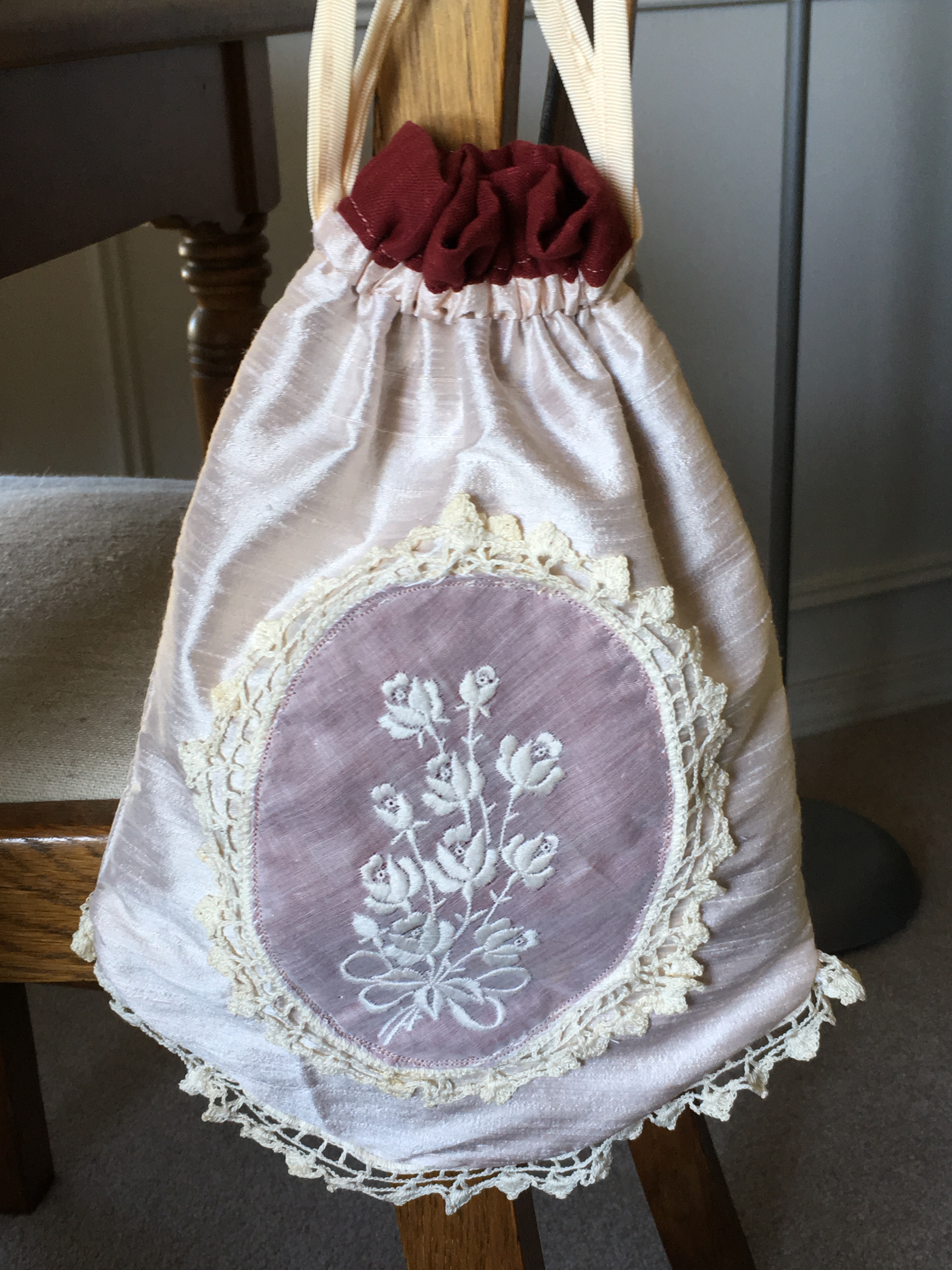
I have several vintage handkerchiefs that have lovely lace on them.  I wanted to use a couple of them in making a reticule to go with my gown for the ball at the JASNA Annual General Meeting in September.  The gown is of a cranberry-color cotton and the over-dress is a blush-color dupioni silk.  I had one handkerchief that had roses embroidered on a corner and I thought that would be perfect for a reticule as a center applique.  I had another linen handkerchief with crocheted lace (cotton, I think) for a nice lace border decoration.  I planned to use the blush color silk for the body of the bag.

dressbag

  1. My first step was to find some inspiration online for reticules. I found a great Pinterest page on “Regency Bags and Reticules”  https://www.pinterest.com/CeruleanHMC/regency-bags-and-reticules-1795-1830/  that had many wonderful period examples.  There was one bag especially that caught my eye from the Museum of Fine Arts in Boston because it had roses, had a drawstring, and was made out of silk.  It was also about the size that mine ended up being.  Although it was painted instead of embroidery, it was good inspiration for me.

reticule MFA

Reticule MFA:  https://www.mfa.org/collections/object/bag-115924


  1. I started by creating the center applique of the roses. The cotton of the handkerchief was quite sheer, so I backed it with the cranberry color of my gown, using the sturdy cotton that was used for the lining.  I first pinned the handkerchief over the cotton backing measuring so that the embroidery would be centered.  After I pinned it and cut a rough oval bigger than I needed, I folded over the edges and basted the two fabrics together, making sure to keep the piece even and centered all around.  Next, I took the lace from another handkerchief and pinned it to the back around the edge of the oval, trying to get it as even as possible.  I basted the lace onto the oval applique, leaving some of the linen from the handkerchief to secure the layers on the back.  When I got to the lace on the corner of the handkerchief, I had to cut the linen close to the lace to get it to lay as straight as possible, but I was able to complete the full oval with two sides of the handkerchief.

centerapplique

  1. Once the applique was basted, I decided on the dimensions of the reticule based on the size of the center applique. I wanted to have about one and a half to two inches of the silk on the sides and bottom (which I made round to echo the oval applique) and I left more space at the top of the fabric for the drawstring.  I ended up with finished dimensions of about 8.5 inches by 12 inches, including the top border.  The pattern that I created for the silk was about 9.5 by 12 because the border at the top was a different color.  Once the silk was cut for the bag, I basted the oval applique on the right side of the fabric toward the bottom with even margins for sides and bottom.  After it was basted, I machine-stitched it twice right around the perimeter of the applique, through the layers of the applique and the linen that holds the lace border.


  1. On the other side of the silk fabric I basted the lace for the bottom of the bag on the right side of the fabric, pointing the lace toward the top of the bag and sewing along the linen border that was left from the handkerchief. I had to hand-sew two pieces of lace together to make a lace piece that was long enough because I had to cut out some stains from the lace border on the old handkerchief.   I made sure to tack down the lace at the sides so that it would not get caught in the side seams when the bag was stitched together (see drawing).  I basted the two bottoms sides together to be sure the lace was positioned correctly and then I sewed the sides and the bottom of the bag and turned it right side out.  The bottom lace is not perfectly aligned, but pretty close.


  1. I made a lining of the same sturdy cotton fabric that was used for the applique, using the same dimensions as for the bag. I sewed the sides of the lining, but left the bottom open for hand-sewing after the lining was sewn to the bag.  I also created a small band at the top of the bag of the fabric of my gown, which is a looser weave (as wide as the lining and about 3 inches long).  I sewed the sides of the border and attached it to the bag and the lining, pinning right sides together and matching side seams.  Once the lining was complete, I turned the bag right side out and then hand-sewed the bottom of the lining closed using a slip stitch.  I put the lining inside the bag and made the border even at the top. Next, I sewed two lines around the bag near the top border to create the pocket for the drawstrings, leaving about 5/8-3/4 inch for the drawstrings to move freely.  I opened the seams on the outside of the bag in the pocket for the drawstring.  The drawstrings were created by folding a one-inch wide ribbon in thirds and then sewing down the middle.  One drawstring came out on one side of the bag and the other on the other side, so that it is easy to cinch and open the bag.  I threaded the drawstrings through using a safety pin to push them through and it required a little maneuvering to get the drawstrings out on each side.  Once they were out I made them even and knotted the ends, hand sewing the end of the ribbon to keep it from unraveling.

reticule

  1. Once the bag was completed, I realized that I had to tack down the lace around the central applique because it flopped over the top when it was held upright. After doing that, the bag is ready to go.  The finished dimensions of the bag are 8.5 inches by 12 inches, the perfect size for my Emma and other necessities.bagEmmacrop.JPG


Uncategorized

Jane Austen and the British Navy

JANAVYrev

Jane Austen and the Navy by Michele Larrow

In Persuasion and to a lesser extent in Mansfield Park, Jane Austen incorporates details about naval life that are very realistic and also connect to the themes of her works.  At our meeting on Sunday July 29, 2018 at the Coeur d’Alene public library, we will explore how Jane Austen portrays the British Navy and naval characters and how these characters contrast with the other characters in the novel, mainly focusing on Persuasion.  Below we present a couple of the themes that are discussed in the two optional readings you can find on the JASNA.org website.  You do not need to read these articles before the meeting, but if you have time to do so, they are quite informative!

Women and the Navy

“I Hate to Hear of Women on Board”: Women aboard War Ships by Rowland McMaster, Persuasions On-Line, 36, 2015.

This excellent article discusses what it might be like to be a woman on board a ship if one were married to the captain, or married to a petty officer, or a sex worker.  Mrs. Croft’s experiences reflect being a woman on board when her husband is a captain. When Mrs. Croft and her brother, Captain Wentworth, discuss ladies being on board ship, Captain Wentworth declares: “ I hate to hear of women on board, or to see them on board; and no ship, under my command, shall ever convey a family of ladies anywhere, if I can help it”.  (69)  Mrs. Croft brings in her own experience and speaks the memorable lines:

“Oh Frederick!—But I cannot believe it of you.—All idle refinement!—Women may be as comfortable on board, as in the best house in England.  I believe I have lived as much on board as most women, and I know nothing superior to the accommodations of a man of war. . . . My dear Frederick, you are talking quite idly.  Pray, what would become of us poor sailors’ wives, who often want to be conveyed to one port or another, after our husbands, if every body had your feelings? . . . But I hate to hear you talking so, like a fine gentleman, and as if women were all fine ladies, instead of rational creatures. We none of us expect to be in smooth waters all our days.’” (69-70)

Mrs. Croft argues that women are rational, just like men.  She is portrayed as a woman of good sense, who is described by the lawyer Mr. Shepard as “more conversant with business” (22) than the admiral was when they discussed renting Kellynch.  In another scene, Anne reflects that the way she manages the admiral’s driving so they don’t turn over is a similar to the way she manages him and their marriage.  We might think of Mrs. Croft as a role model for Anne of how to be a naval wife and to have an equal marriage.

Some questions we will discuss:  How does being affiliated with the navy through marriage to a naval officer allow a woman greater freedom of travel and activity?  Are the naval marriages that are portrayed (the Crofts and the Harvilles) more egalitarian than those of the Musgroves (older and younger)?  What kind of married life do we imagine Anne will have when she is connected with the navy?  How does Mrs. Croft compare and contrast to Lady Russell and Mrs. Musgrove?

The Connections between Jane Austen’s Family and Naval Characters

“The Influence of Naval Captain Charles Austen’s North American Experiences on Persuasion and Mansfield Park” by Sheila Johnson Kindred Persuasions, 31, 115-129, 2009

Sheila Johnson Kindred focuses mainly on Jane Austen’s younger brother Charles and his wife Fanny in finding connections between their lives and friends in Halifax and Bermuda and characters and events in Persuasion. Kindred concludes that Austen took the information she had from Charles and applied it in a complex was in her novels.  “Through her communication with her brother Charles she had access to a personal narrative about the world of a naval station.  For more than six years, Charles related his own accomplishments; he reported the enterprises of his fellow officers and recorded the lives of his own young family.  This rich database gave Jane Austen an intriguing catalogue of sentiments, feelings, attitudes, and personality traits that animated naval life.  We can appreciate the quality of Jane’s fiction by the way she imaginatively selected items from this catalogue and reworked them to her own purposes in the construction of the unique range of character traits, opinions, and actions which brings to life her naval characters” (Kindred 126).

Some questions we will discuss:  What is the portrayal of a father’s feelings for his children shown in Charles Musgrove compared to Captain Harville?   A few of the naval characters as shown to have good hearts, but not the best social manners.  Which trait is more valued in Persuasion?  Sir Walter’s criticisms of the navy are humorous, but the contrast between him and Admiral Croft show his moral failures as a landowner.  Is Austen using the contrast between the navy and the landed gentry to make predictions about the future of England?

The Ending of Persuasion

The ending of Persuasion specifically includes a connection with the navy for Anne’s happiness and the uncertainty of the future:

Anne was tenderness itself;–and she had the full worth of it in Captain Wentworth’s affection. His profession was all that could ever make her friends wish that Tenderness less; the dread of a future War, all that could dim her Sunshine.—She gloried in being a Sailor’s wife, but she must pay the tax of quick alarm, for belonging to that Profession which is—if possible—more distinguished in it’s Domestic Virtues, than in it’s National Importance.—Finis July 18.—1816” (p. 273, spelling, punctuation, and capitalization from the draft of the final chapters)

Kindred and other authors suggest that by incorporating the Navy, Austen is bringing the larger world of current events and war into her novels, which readers of her day would have known.  Persuasion start the story in 1814 when there is peace with France and finishes in spring of 1815.  The Battle of Waterloo happened in June 1815 after Napoleon left exile and peace was shattered.  Readers of the day (1817 or 1818) would have known that the peace in Persuasion would soon be gone.  Any thoughts about how that would inform their understanding of the end of the novel?  Thinking about the “tax” of being a wife of a naval officer, what might Austen be saying about life in general?

Pages are from:  Austen, Jane.  Northanger Abbey and Persuasion.  Ed. R. W. Chapman.  3rd ed.  London: Oxford UP, 1966.

Bring other questions for discussion.  If you have read the letters or know something about the lives of her two naval brothers, Charles and Francis, bring that for discussion.  We hope to see you on July 29!

Michele Larrow, Regional Co-Coordinator