featured, featured, Information

The Regency Shrubbery in Fine Weather

Michele Larrow, Regional Co-Coordinator

“The gardens or pleasure grounds near a house may be considered as so many different apartments belonging to its state, its comfort, and its pleasure.” Humphry Repton, Fragments 165

Jane Austen would likely agree with Regency-era landscape gardener Humphry Repton that the gardens or pleasure grounds around the house are a source of comfort and pleasure; her heroines experience the beauty of nature and freedom to roam in the pleasure grounds near a house. During the Regency era, the pleasure grounds were part of the estate, typically near the house, that contained flower gardens and shrubberies, as well as ornamental woods with paths. The kitchen gardens, orchards, and greenhouses or hot houses usually were in a different location than the pleasure grounds, and also near the house (see our two previous blogs: The Donwell Abbey Kitchen Garden and Orchard and Mr. Darcy’s Fruit for further information). The park was a separate part of larger estates used for hunting and riding, which was often left in a more natural state. During the Georgian and Regency periods, shrubberies were important garden elements that were found even in smaller houses and cottages, such as Austen’s last home at Chawton Cottage. Shrubberies are mentioned in the six novels, in a couple of stories in the Juvenilia, and in Lady Susan (29 times for “shrubbery” and 9 times for “shrubberies”). This blog uses ten quotations from Austen’s works and letters to discuss five aspects of shrubberies and other elements of the Regency pleasure grounds.

A Note about the Austen Texts: The Cambridge Edition of the six novels is used for almost all references, except for Chapman’s Minor Works (MW) for Lady Susan and when Chapman’s chronology is consulted and then the Chapman edition Appendices are cited. As is standard, NA=Northanger Abbey, SS=Sense and Sensibility, PP=Pride and Prejudice, MP=Mansfield Park, E=Emma, and P=Persuasion. The full citation for each novel is listed in the Works Cited at the end of the blog.

A Note about Illustrations: In her works and letters, Austen mentions almost forty ornamental trees and shrubs that were planted in the shrubbery.  On our website, I have previously catalogued Austen’s trees and shrubs with the relevant quotations that mention that shrub or tree and photographs of what the plants look like now (see Austen’s Trees and Shrubs A-K and Austen’s Trees and Shrubs L-Z).  For the current blog, I collected Georgian and Regency-era botanical illustrations of all those plants, some of which are used in the header image (Illustration 1 in the Illustration Credits) and all of which are shown in Illustration 2 and 3.  A separate Illustration Credits is available at Shrubbery Illustration Credits , and it includes links to the full-size botanical illustrations used here. All the botanical images used are in public domain.

Illustration 2 Trees and Shrubs Over 30 Feet and Illustration 3 Trees and Shrubs Under About 30 Feet

Section I What Did Shrubberies Look Like throughout the Year?

“Our young Piony at the foot of the Fir tree has just blown & looks very handsome; & the whole of the Shrubbery Border will soon be very gay with Pinks & Sweet Williams, in addition to the Columbines already in bloom. The Syringas too are coming out.” Jane Austen’s Letters, Wednesday 29 May 1811 from Chawton to Cassandra

“It was hot; and after walking some time over the gardens in a scattered, dispersed way, scarcely any three together, they insensibly followed one another to the delicious shade of a broad short avenue of limes, which stretching beyond the garden at an equal distance from the river, seemed the finish of the pleasure grounds.” Emma 390-391

In the novels, we do not get much detail about what a shrubbery looks like, although there is some sense of how extensive they are in different settings. In Austen’s letters, we get more information about the shrubs, trees, and flowers that grow in the shrubbery, as well as a sense of their dimensionality, as we see in the quotation above from Austen’s letter when living at Chawton.  Shrubbery could be borders around a lawn or meadow (as at Henry Tilney’s parsonage, Woodston, where the shrubbery is “round two sides of a meadow” NA 221); clumps of shrubs and flowers on a grass lawn; or bigger plantings with serpentine paths through them on larger estates.  Shrubberies were typically located near the house for easy access. [For example, Illustration 4-1, below, from Repton in 1816 of Cobham Hall, Kent, shows shrubberies (highlighted in green) interspersed in a large plantation of trees surrounding the house, and the kitchen garden (highlighted in purple) is located near the house, stables, and shrubbery].  

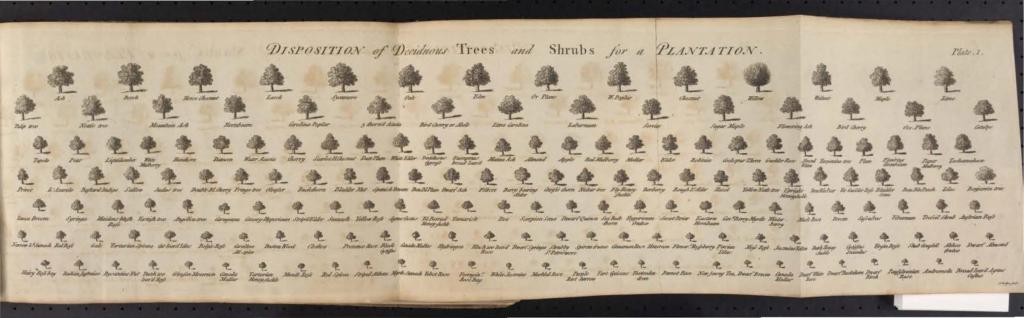
Shrubberies were almost always planted in the “theatrical” manner, with shorter plants in front and taller plants behind, sometimes many rows deep (see the header illustration for an example.) For taller shrubs, increasing space was allowed between rows (and within the row between plants) and it was recommended to have about 10 feet or more between rows of trees (Loudon 1006-7), so that larger plants had space to grow.  Thus, on large estates, the shrubbery border could be over sixty feet wide if there were ten rows with 6 rows of shrubs and 4 rows of trees. In 1779, James Meader created two illustrations of deciduous and evergreen shrubs and trees ranked in rows by height to tell planters where in the shrubbery to locate a specific plant (Illustration 4-2 and 4-3, below) and he includes almost every shrub and tree mentioned by Austen. I created two similar pictures in color using botanical illustrations for each of the trees and shrubs mentioned in Austen’s works and letters, grouped by height, in descending order (Illustration 2 Trees and Shrubs Over 30 Feet; Rows I, II, III and Illustration 3 Trees and Shrubs Under About 30 Feet; Rows IV, V, and VI, above). Table 1 (below) corresponds with Illustration 2 and 3 and lists all the trees and shrubs mentioned by Austen that are used for ornamental purposes in the pleasure grounds in order from tallest to shortest, along with details about the current scientific name, the works where Austen mentions the plant, whether it is deciduous or evergreen, the month and color of blooms (using English Regency-era or slightly later sources), and whether it is native to the UK or the year it was first imported.

Table 1 Ornamental Trees and Shrubs Mentioned in Austen’s Works

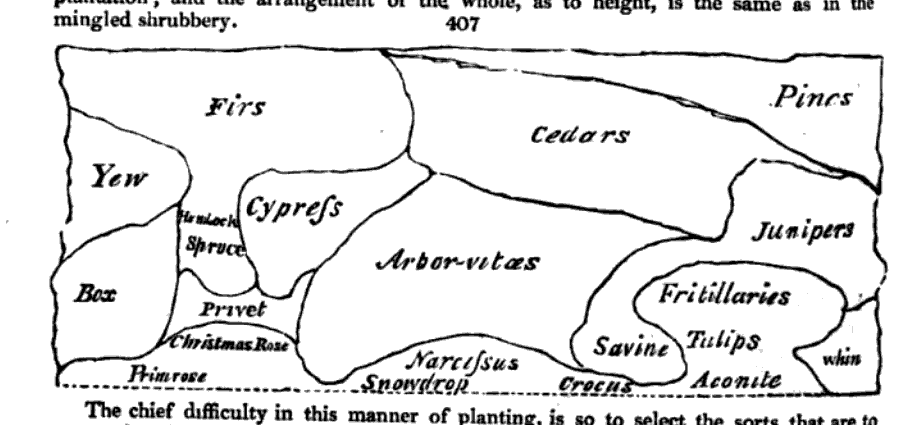
The shrubbery border could include herbaceous flowers in the front but often was just woody flowering shrubs and ornamental trees.  Shrubberies were often planted in the “mingled” manner with a variety of colors, blooming times, and whether a plant was deciduous or evergreen (Loudon 1006).  Similar to how kitchen gardens were planted, the aim for shrubberies was to have as many different varieties blooming and in leaf for the longest time. For very large shrubberies, Loudon (1006-1007) suggested varying the month of blooming (6: March to August), color of bloom (4: red, yellow, white, purple), and evergreen or deciduous alternated within each row of plants grouped by height, which results in as many as 48 different plants in one row, although typically evergreens would have to be repeated, since there are fewer evergreens compared to deciduous plants (by a 1 to 12 ratio according to Loudon). Plants could also be planted in the “massed” manner, where several plants of all one kind were grouped together, although still in graduated heights (see Illustration 4-4, below, from Loudon of various evergreens arranged to show a variety of colors of green and texture of foliage 1008). Laird notes that the front row of the shrubbery often included unusual imports or plants that were especially beautiful, noting how on Meader’s evergreen plantation there were taller exotics from North America and Southern Europe mixed in with the shorter evergreens: “Meader’s ranking of the various plants is more intelligible as an equation of height multiplied by either beauty or rarity, cost or singularity” (250).

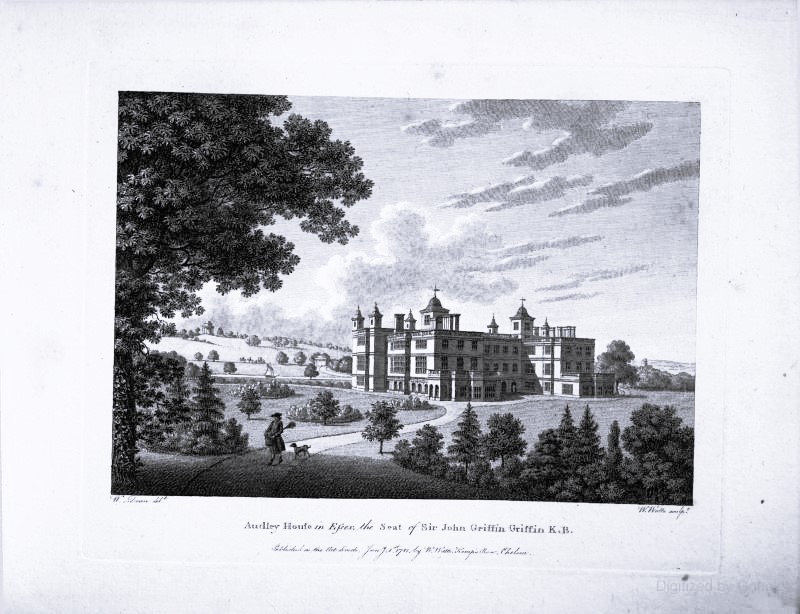
To see what shrubberies looked like in Austen’s lifetime, pictures of Audley End House offer excellent examples (see Laird 341-4).  Illustration 4-5 (below) is an image from William Watts’ The Seats of the Nobility and Gentry (1779; a book that also features Edward Austen’s home Godmersham Park and was in his library), which shows Audley End House in an engraving, with shrubbery and flower beds in the foreground.  Audley End was built in the early 1600s in Saffron Walden, Essex and is also featured in a series of full color paintings by William Tomkins in 1788 that shows shrubbery and gardens in several of the pictures (these paintings are privately owned and can be accessed through this link: Art UK Tomkins Link). Click on each painting to see the image and then right click to see a larger image in another tab:  Audley End from the Southwest shows acacia trees (black locust, which are mentioned in SS as discussed in Section II) on both sides of the view; Audley End, the Tea House Bridge shows a tea house overlooking water with shrubbery on the sides; Audley End, View from the Tea House Bridge shows more shrubbery, including orange trees in pots sunk into the shrubbery (see Section IV); Audley End and the Ring Hill Temple and Audley End and the Temple of Concord both show temples in the landscape (see Section IV).

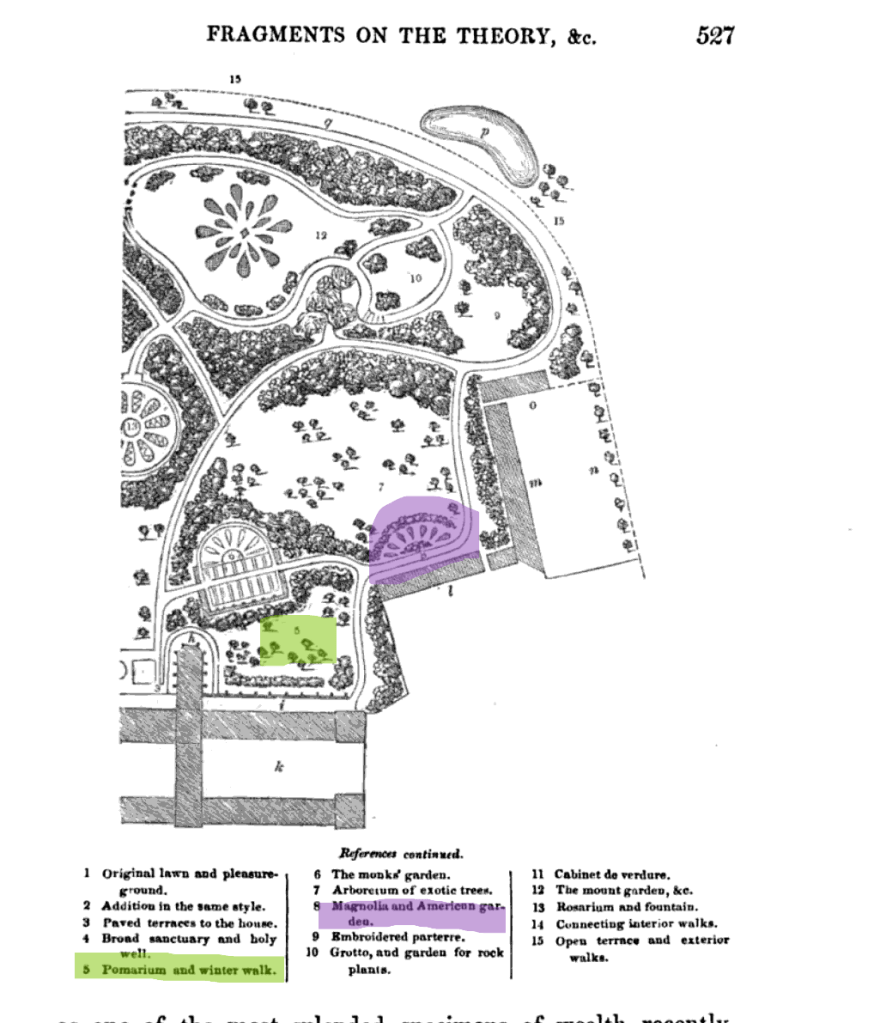
Shrubberies were used year-round in the Regency, even Mr. Woodhouse takes his “three turns—my winter walk” (E 61).  The walks in the shrubbery were often gravel or sand, or occasionally grass (see Loudon 1006) to ensure good drainage in rain or snow. Loudon recommends shrubbery walks of one to two miles for exercise, starting close to the house, and planting on one side for views, and using circuitous rather than straight lines (1005-6).  Recall that when Sir Thomas sends Fanny to the shrubbery after Mr. Crawford’s rejected proposal, it is early January (MP Chapman Edition “The Chronology of Mansfield Park” 555).  He tells her: “I advise you to go out: the air will do you good; go out for an hour on the gravel; you will have the shrubbery to yourself, and will be the better for air and exercise” (MP 371).  In Northanger Abbey, after Catherine has been at the Abbey several days and when Henry is away, she became “tired of the woods and the shrubberies–always so smooth and so dry” (218) even though it is still winter. Landscape gardener Humphry Repton often included specific “winter garden[s]” that were in sheltered areas near the house as part of his plans for large estates (see Illustration 4.6 and 4.7 of Repton’s map for Ashridge, with a winter garden highlighted in green on Illustration 4.7. A color map from the Red Book for Ashridge shows the same areas labeled more clearly (see the Resources list at the bottom of the blog for “Hardy Plants and Plantings for Repton and Late Georgian Gardens [1780–1820]”; the Ashridge map is on page 23 of the PDF.) When shrubberies were planned, care was taken to be sure that at least some of them could be used in all seasons.

Illustration Set 4 Miscellaneous Shrubbery Prints

In several of her letters to Cassandra, Austen focuses on what is blooming or fruiting in the garden, as in the letter above which mentions the “piony”. About half of the trees and shrubs mentioned by Austen bloomed in May in England (see Table 1), similar to the effusion of blooming that happens in May in Eastern Washington.  In Emma, the characters seem to be especially attuned to the seasonal changes in nature: for example, in February, Emma wonders if the elder will be coming out soon, foretelling spring (E 203).  When the Highbury folks go to Donwell Abbey “at almost Midsummer” (388) and walk to the avenue of lime trees, it is important to know that limes in England (called lindens in the United States) bloom right around the time of the strawberry picking party (June 23, see the Chapman Edition, “The Chronology of Emma” 497).  At midsummer on a hot sunny day, lime trees would be a heady perfumed mass of yellow flowers surrounded by buzzing bees (Miller 174; see video 1).  Emma’s use of the word “delicious shade” (390) for the avenue of limes reflects the full sensory experience of limes in bloom.  When Emma has joined Mr. Knightley and Harriet in the lime avenue and “They took a few turns together along the walk.—The shade was most refreshing, and Emma found it the pleasantest part of the day” (392), Austen highlights the natural and emotional harmony available for Emma with Mr. Knightley at Donwell Abbey.

Video of Lindens surrounded by bees, taken early July at Lawson Gardens, Pullman, WA by Michele Larrow

Section II What Plants Were Valued in the Georgian and Regency Shrubbery?

Cleveland was a spacious, modern-built house, situated on a sloping lawn. It had no park, but the pleasure-grounds were tolerably extensive; and like every other place of the same degree of importance, it had its open shrubbery, and closer wood walk, a road of smooth gravel winding round a plantation, led to the front, the lawn was dotted over with timber, the house itself was under the guardianship of the fir, the mountain-ash, and the acacia, and a thick screen of them altogether, interspersed with tall Lombardy poplars, shut out the offices.” Sense and Sensibility 342-343.

“I am so glad to see the evergreens thrive!” said Fanny, in reply. “My uncle’s gardener always says the soil here is better than his own, and so it appears from the growth of the laurels and evergreens in general. The evergreen! How beautiful, how welcome, how wonderful the evergreen! When one thinks of it, how astonishing a variety of nature! In some countries we know the tree that sheds its leaf is the variety, but that does not make it less amazing that the same soil and the same sun should nurture plants differing in the first rule and law of their existence.” Mansfield Park 244

Fanny’s rhapsody on the common laurel (Prunus laurocerosus) makes sense in the context of the rarity of native evergreens in Britain and the frequent use of imported evergreens in the shrubbery.  Marshall notes that laurel is “the stock plant in shrubberies and other ornamental grounds” (318) and is an import from around the Black Sea (311). Laurel is mentioned twice in Mansfield Park, at the Mansfield Parsonage (244) and in the wilderness at Southerton (106); Mrs. Elton notices the laurel at Hartfield “[s]o extremely like Maple Grove!” (E 294); and there is a laurel hedge at the Collins’ Hunsford parsonage (PP 176). According to Laird, there are seven native British evergreens: yew, holly, box, juniper, spurge laurel, butchers broom, and Scots pines (393, note 36). Four of these native evergreens are mentioned by Austen, sometimes connected with a garden: Mrs. Jennings mentions that there is an ”old yew arbour” at Delaford (SS 223) and in Mansfield Park, Henry Crawford mentions yews around a farm house when he was lost and stumbled on Edmund’s future parsonage (280); a holly branch helps to hide Anne in the hedgerow where she overhears Captain Wentworth talking to Louisa (P 95); Box Hill of Emma fame (399) is named after the “extensive plantations of box” (Marshall 91) that grow there; and the “thick grove of old Scotch firs” in Northanger Abbey that attract Catharine are Scots pines (183).  Other evergreens that Austen mentions that were imported include spruce, fir, lavender, and myrtle (see Table 1).  Evergreens were especially valued both for timber and for the year-round green color in the pleasure grounds. 

Laird (especially 61-98) details the explosion of interest in England for American plants in the 1700s, especially flowering trees or shrubs that were also broadleaf evergreens, such as evergreen magnolias, rhododendrons, azaleas, and mountain laurel (kalmia).  There is an Austen connection for the use of American exotics as Laird reports that nursery bills for James Leigh, the cousin of Jane Austen’s mother, at Adlestrop in 1762-63 show orders for many American exotics including rose acacia (Robinia hispida), Hydrangea, New Jersey tea (Ceanothus americanus), Catalpa bignoniodes, a Magnolia grandiflora, and Rhododendron maximum (156-157). Jane and her family visited their family cousin the Rev. Thomas Leigh at Adlestrop Parsonage in 1806 after the improvements of Humphry Repton in 1799 at the parsonage and Adlestrop for Rev. Leigh and James Leigh’s son, James-Henry, who was the current owner of Adlestrop (Batey 81; Letters Biographical Index “Leigh families” 548-49) and these American exotics would be mature trees by then. Repton’s plan for the Ashridge gardens includes a Magnolia and American garden (Illustration 4.7, highlighted in purple, above).  Harvey estimated that once a tree or shrub was imported to London or large estates, it would take about 20 years for the trees to get out to the smaller planters in the country. The acacia (Robinia pseudoacacia; sometimes also called false acacia) mentioned at the Cleveland estate in Sense and Sensibility was an import from America (where it is called black locust) which Abercrombie says does well in open plantings in England and was valued for its sweet smelling, pendulous blossoms (ROBINIA). The English also imported American maples such as the sugar maples and scarlet maples (Laird 86) that were much taller trees than the native English or field maple. I think that the maples at Mrs. Elton’s nouveau riche brother-in-law’s seat, Maple Grove, in Emma were the tall imports from America for the grandest effect.  Marshall mentions many American varieties of English native trees that were also grown in the shrubbery and ornamental woods, such as American limes (or lindens, 413); oaks, including the evergreen live oak as well as the white, red, and black oaks (311); and many conifers, which were all classed as Pinus at that time, such as Weymouth or white pine, Newfoundland spruce fir, and Hemlock-fir (282-283).  Laird examined bills from nurserymen for large estates and found in the mid to late 1700s that orders would include “large quantities of evergreen and flowering shrubs bought in bulk” (50-100 plants) such as laurels, hollies, lilacs, syringas, roses, laburnums, and honeysuckles among others and then “the very small quantities of special plants bought as curiosities”, which often included more expensive imports from America (152).  Because America had a similar temperate climate to England in many parts of the America of the 1700s, trees and shrubs from America could be grown outdoors and did not need as much winter protection as did imports from more tropical locales.

Section III How Are Shrubberies Used in Austen’s Works?

“The weather continued much the same all the following morning; and the same loneliness, and the same melancholy, seemed to reign at Hartfield—but in the afternoon it cleared; the wind changed into a softer quarter; the clouds were carried off; the sun appeared; it was summer again. With all the eagerness which such a transition gives, Emma resolved to be out of doors as soon as possible. Never had the exquisite sight, smell, sensation of nature, tranquil, warm, and brilliant after a storm, been more attractive to her. She longed for the serenity they might gradually introduce; and on Mr. Perry’s coming in soon after dinner, with a disengaged hour to give her father, she lost no time in hurrying into the shrubbery.” Emma 462.

“Reginald is never easy unless we are by ourselves, and when the weather is tolerable, we pace the shrubbery for hours together.” Lady Susan, Letter 16 Lady Susan to Mrs Johnson MW 268

Shrubberies are places where characters go for outdoor exercise, for self-reflection and soothing, or to have the privacy to meet romantic partners or to discuss important personal events with family or friends.  At Netherfield, Mr. Darcy and Miss Bingley walk in the shrubbery without any romantic intent, at least on Mr. Darcy’s side, and he tries to accommodate both Elizabeth and Mrs. Hurst into the walk when they meet them, also out walking, on a narrow path (PP 57-58).  Catherine and Eleanor enjoy walking in the shrubbery at Northanger Abbey (218). Even indolent or invalid characters enjoy their sheltered spaces–Mr. Woodhouse “never went beyond the shrubbery, where two divisions of the grounds sufficed him for his long walk, or his short, as the year varied” (E 25) and Lady Bertram tells Mr. Rushworth she likes to get “’out into a shrubbery in fine weather’” (MP 65).

Both Fanny and Emma use the shrubbery for reflection and to soothe themselves when troubled, and shrubberies afford them the privacy to have important conversations there with the men they will marry. When Emma is distressed about the possibility that Mr. Knightley will marry Harriet and tries to fully understand “the blindness of her own head and heart!—she sat still, she walked about, she tried her own room, she tried the shrubbery. . .” (E 448), and eventually she acknowledges her errors and realizes the depth of her love for Mr. Knightley.  Fanny is eager to follow Sir Thomas’s advice to go to the shrubbery after he has berated her for rejecting Henry Crawford (MP 371).  Later, she avoids walking alone in the shrubbery to avoid a scolding by Mary Crawford. who is angry that Fanny has rejected Henry (412).  Edmund is sent by Sir Thomas to talk to Fanny in the shrubbery, and Edmund wants her to “open her heart to” him, to “have the comfort of communication” (399).  Although Edmund does not understand the depths of Fanny’s distrust of Henry, he is aware of her feeling “oppressed and wearied” by their talk and takes her into the house (410).  After the rupture with Mary caused by Maria’s elopement with Henry Crawford, Edmund recovers emotionally by “wandering about and sitting under trees with Fanny all the summer evenings” (535), and eventually he realizes that he loves her romantically.  Both the heroes and the heroines can find solace with others in the shrubbery.

Shrubberies are especially associated with newly married couples and those getting engaged.  In Mansfield Park and Northanger Abbey, the parsonage where each heroine will ultimately live is described as having a young shrubbery about “half a year” old (NA 221) or of three years growth (from when the Grants moved into the parsonage; MP 243). The “project[ing of] shrubberies” is one of the activities of the newly married Elinor and Edward (SS 425). Shrubberies are also places where engaged lovers can have privacy, such as when Jane and Bingley escape to the shrubbery to avoid Lady Catherine (PP 389). Lady Susan and Reginald “pace the shrubbery for hours together” in Lady Susan, and Mrs. Vernon is aghast that it is often in view of Lady Susan’s daughter, whose bedroom overlooks the shrubbery (MW 268, 271). When Emma and Mr. Knightley walk together in the shrubbery after a rain shower in early July (probably July 8 based on the Chapman Edition’s Chronology of Emma 498), they might be enjoying the sight and smell of late June and early July Austen floral favorites such as lime tree blossoms, roses, honeysuckle, lavender, and syringa (Miller 200, 236).  After Mr. Knightley consoles Emma for the loss of Frank Churchill, and Emma tries to promote his happiness, even though she imagines he will choose Harriet, they are able to resolve their misunderstandings and declare their love, on their way to “perfect happiness” (E 471).

Section IV Greenhouses and Other Architectural Elements of Pleasure Grounds

“. . .for here are some of my plants which Robert will leave out because the nights are so mild, and I know the end of it will be that we shall have a sudden change of weather, a hard frost setting in all at once, taking every body (at least Robert) by surprise and I will lose every one;” Mansfield Park 247-248

“Miss Bennet, there seemed to be a prettyish kind of a little wilderness on one side of your lawn. I should be glad to take a turn in it, if you will favour me with your company.”  “Go, my dear,” cried her mother, “and show her ladyship about the different walks. I think she will be pleased with the hermitage.” Pride and Prejudice 391

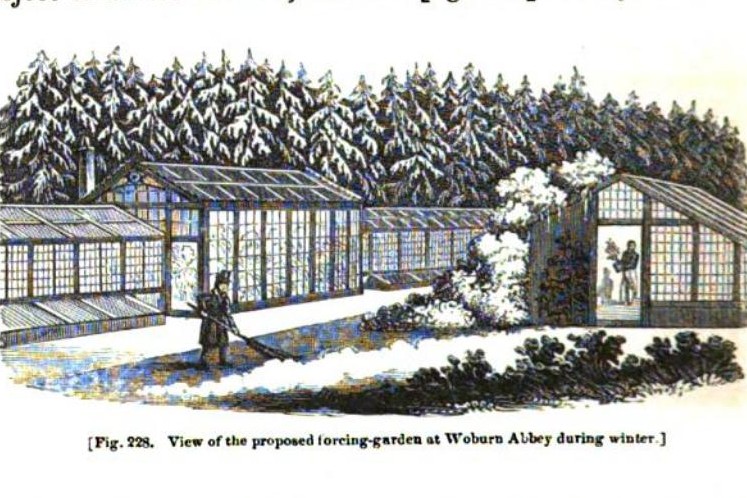
Many gardens had greenhouses for sheltering plants that needed to be protected during the winter and could be heated if the weather were freezing, as Catherine notes about the Allens’ “one small hot-house, which Mrs. Allen had the use of for her plants in winter, and there was a fire in it now and then” (NA 183). A greenhouse is mentioned at Cleveland, when the Dashwood sisters go outside with Charlotte “dawdling through the greenhouse, where the loss of her favorite plants, unwarily exposed, and nipped by the lingering frost, raised the laughter of Charlotte” (SS 343; see Illustration 5.1, below, from Repton of a simple greenhouse).  Tropical plants would need much more heat and were kept in hothouses that needed constant heat sources, such as the pinery that General Tilney casually mentions for growing his (very expensive) pineapples (NA 182).  Mrs. Grant talks about her gardener leaving her plants out when there is a threat of frost and a few paragraphs later, Mary Crawford states that she plans to be rich enough to purchase as much myrtle as needed (MP 247-48); myrtle is a plant that would have grown in a greenhouse in Northamptonshire, thus clarifying why Mary mentions it (see Abercrombie MYRTUS and Loudon 1094).  Laird discussed how greenhouse plants would be taken out of the greenhouses in the summer and sometimes put into the ground in their pots in the shrubbery, especially citrus trees and other showy exotics (see 133-172). Greenhouses were places to grow beautiful plants that needed more protection in winter and that could become places for winter exercise if they were big enough (see Repton Fragments 552). Illustration 5.2, below, shows Repton’s drawing of the forcing houses at Woburn Abbey in winter, perhaps something like what Austen had in mind for the kitchen gardens at Northanger Abbey.   

Austen would be familiar with the use of temples and other buildings in landscape gardens through her visits to Godmersham, home to her brother Edward Austen Knight. At  Godmersham, “just outside the park was a small rounded hill on top of which, within the woods, was a summer house which had been built by the Knights earlier in the eighteenth century as a Grecian temple in the Doric style with a portico entrance of fluted columns and marble steps, and a fine grassy walk leading up to it” (Le Faye 237-8).  Batey has a picture that shows the side of the temple and the view from it across the river Stour to the mansion, and remarks that Austen enjoyed sitting in the temple “where she would think out further plots for her novels” (102). The “Grecian temple” at Cleveland where Marianne tries to imagine seeing Combe Magna, Willoughby’s estate 30 miles distant, and where she plans a “twilight walk” (SS 343-4), is probably modeled on Godmersham’s temple.

In Northanger Abbey, Catherine is lured to a drive with John Thorpe by the prospect of “Blaize Castle”, which Thorpe promises is “the oldest in the kingdom” with “dozens” of towers and long galleries (83).  The joke is that Blaise Castle is a “gothic folly” on a hill overlooking Bristol and the nearby river valleys on the Blaise estate built by a “Bristol sugar-merchant. . . in 1766” (NA note 4 325).  Lane describes the interior: “The design features three ornate castellated turrets, one of which contains the staircase giving access to the flat roof of the central, lower tower.  Traceried windows and cruciform arrow-slits supply the Gothic ornamentation, while stained glass and elegant interior plasterwork supplied the comfort.  There was a vestibule and dining room below, and a main chamber above” (79).  A later owner of the property commissioned Humphry Repton to change the landscape and Illustration 5.3, below, shows Repton’s watercolor of Blaise Castle from the 1796 Red Book for Blaise.  Loudon notes that buildings should be used in the shrubberies “more sparingly, and with greater caution” (1011) than statues or urns and this seems to be an opinion that Austen would concur with.

The hermitage mentioned at Longbourn in Pride and Prejudice reflected an interest in the late 1700s and early 1800s in more natural wooded walks and rustic buildings that would fit into the wooded landscape. “A hermitage, meant to resemble the hut of a religious recluse and to inspire melancholy associations, ought properly to be located in a secluded wooded area, so the Bennets’ hermitage is sited correctly, though perhaps too close to the house for best taste” (Wilson 38).  Repton shared an example of a “rustic thatched hovel”, which was used as a place to rest and observe the views in a hilly wooded area and which he recommended should be covered with vines and use tree trunks in the construction (Observations 255-6; Illustration 5.4 below); this building gives a sense of what more rustic landscape architecture looked like. Batey writes that when Jane Austen was living in Chawton, she would have known the hermitage at nearby Selborne that Gilbert White built behind his house The Wakes (44-46). Catherine expresses pleasure in a “sweet little cottage” among “the apple trees” at Woodston, Henry’s parsonage, and the General embarrasses her when he tells Henry it must be preserved (NA 220).  Temples, covered seats, and tea houses in gardens were widespread and even less affluent families, like the Martins, yeoman farmers, in Emma, have, in Harriet’s words, “a very handsome summer-house” in their garden “large enough to hold a dozen people” where they plan to drink tea next summer (E 27).

Illustration Set 5 Miscellaneous Garden Architectural Elements

Section V The Shrubbery as an Expression of the Estate Owner’s Taste and Wealth

“As to all that,” rejoined Sir Walter coolly, “supposing I were induced to let my house, I have by no means made up my mind as to the privileges to be annexed to it. I am not particularly disposed to favour a tenant. The park would be open to him of course, and few navy officers, or men of any other description, can have had such a range; but what restrictions I might impose on the use of the pleasure-grounds, is another thing. I am not fond of the idea of my shrubberies being always approachable; and I should recommend Miss Elliot to be on her guard with respect to her flower garden. I am very little disposed to grant a tenant of Kellynch Hall any extraordinary favour, I assure you, be he sailor or soldier.” Persuasion 21

The number of acres contained in this garden was such as Catherine could not listen to without dismay, being more than double the extent of all Mr. Allen’s, as well her father’s, including church-yard and orchard. The walls seemed countless in number, endless in length; a village of hot-houses seemed to arise among them, and a whole parish to be at work within the enclosure. The general was flattered by her looks of surprise, which told him almost as plainly, as he soon forced her to tell him in words, that she had never seen any gardens at all equal to them before; and he then modestly owned that, “without any ambition of that sort himself — without any solicitude about it — he did believe them to be unrivalled in the kingdom. If he had a hobby-horse, it was that. He loved a garden. Though careless enough in most matters of eating, he loved good fruit — or if he did not, his friends and children did. There were great vexations, however, attending such a garden as his. The utmost care could not always secure the most valuable fruits. The pinery had yielded only one hundred in the last year. Mr. Allen, he supposed, must feel these inconveniences as well as himself.” Northanger Abbey 182

The shrubbery and woods of the pleasure ground was the domain of men for planning the design for planting but open to women for exercise.  Sir Walter clearly distinguishes that his area of control is the shrubbery and park, and Elizabeth’s area of control is the flower gardens (P 21).  Laird’s review of many different estates from 1700-1800 shows that the male estate owner was the person to whom shrubbery plans and follow-up questions were addressed by landscape gardeners (e.g., the Duke of Argyll at Whitton 83-88 or Lord Petre at Thorndon Hall 63-67), although there are some exceptions, like widows (the Duchess of Portland at Bulstrode 221) or times when the married couple is both addressed and the wife appears to play a role in decisions about pleasure grounds and not just flower gardens (the Duchess and Duke of Portland before his death in 1762 or the Duke and Duchess of Beaufort at Badminton 128). Since men were the predominant property owners in Austen’s time, except for widows like Lady Catherine de Bourgh, it makes sense that they would be the ones to make decisions about the pleasure grounds and the park.

When Catherine explores the shrubbery and kitchen garden with Eleanor and General Tilney, General Tilney is telling her that he is a VERY rich man in detailing his garden woes.  If his gardens are “unrivalled in the kingdom”, that is a big claim considering how much royalty and aristocrats spent on landscape gardens. Natali details the ways in which the General’s off-hand comment that his pinery “yielded only one hundred in the last year” tells someone in the know the vast sums he has spent on pineapple plants to produce 100 pineapples because the plants required being kept in a hothouse with constant heat throughout the year, and each plant took 2-3 years to produce one pineapple. “By pointing to his pinery, General Tilney is asserting that he is not only a man of monetary value but also a man of social value.  Readers would have instantly recognized that General Tilney’s wealth would perhaps have rivaled that of the highest, wealthiest, and most influential group of land-owning aristocrats in England.” Although the General is focused on the expense of his kitchen gardens rather than his pleasure grounds in this example, pleasure grounds were also places to spend lots of money in the Regency era, especially by importing many rare trees and shrubs that needed expensive care. 

Discussions of taste pervade the Regency-era literature on landscape gardening; “taste” is mentioned 100 times in Repton’s collected works and Loudon describes Repton in the introduction as “eminent for his artistical genius and taste” (1840 xii).  Repton compliments the good taste of his royal or noble and wealthy clients, including the Prince of Wales, the Duke of Portland, and the Earl of Darnley (364, 141, and 418).  When Elizabeth explores Pemberly, she forms a favorable opinion about the taste and values of Mr. Darcy in a way that corresponds with the Georgian and Regency focus on gardens and landscape grounds as an expression of the owner’s taste. The language that Elizabeth uses when she sees Pemberly reflects her sense of Darcy’s good taste: “. . . in front, a stream of some natural importance was swelled into greater, but without any artificial appearance. Its banks were neither formal nor falsely adorned. Elizabeth was delighted. She had never seen a place for which nature had done more, or where natural beauty had been so little counteracted by an awkward taste.” (PP 271).  Later when Elizabeth and Mrs. Gardiner visit Georgianna, the view is beautiful and the trees have special meaning: “Its windows opening to the ground, admitted a most refreshing view of the high woody hills behind the house, and of the beautiful oaks and Spanish chestnuts which were scattered over the intermediate lawn.” (295).  Oaks and Spanish chestnuts are noted by Repton to be preferred for English landscapes rather than quicker-growing larches and spruce firs which are grown for profit (Fragments 46). Marshall notes that the Spanish or sweet chestnut grows to “a great height” and is good as an ornamental (167).  He also goes on at length about the historical importance of oaks to England, especially for shipbuilding “the oak raised us once to the summit of national glory” and comments on its beauty as an ornamental tree as well (314).  Because oaks take so long to attain full maturity, growing them is a commitment to the future and reflects Mr. Darcy’s stability as well as his taste and Englishness.

Critics of Austen’s work note that small details reveal much when you understand the historical and cultural context, as the annotations in the Cambridge editions of the six novels (2005-2006) attest. In the Regency era shrubberies were constructed with a large variety of trees and shrubs from America and Europe as well as England, presented “theatrically” in ascending height.  Plants were chosen to bloom for as long as possible and included many evergreens since the shrubbery was used year-round.  In the novels, shrubberies are important places for Austen’s heroines to experience nature, exercise, reflect, and most importantly, to have privacy for important conversations away from other family members. Pleasure grounds and other landscape elements revealed the wealth and taste of the owner and included architectural elements as places to enjoy views, rest, and, perhaps, take refreshment.

RESOURCES

For more information about Humphry Repton, color pictures from some of his Red Books, as well as an extensive list of what trees and shrubs were popular in the late 1700s and early 1800s pleasure grounds, see Sarah Rutherford’s 2018 research report “Hardy Plants and Plantings for Repton and Late Georgian Gardens (1780–1820)” for Historic England, which is available for download at: Repton Research Report from Historic England.

Historian Andrea Wulf has written several engaging and accessible books about the history of English landscape gardening and its cultural impact. This Other Eden: Seven Great Gardens and 300 years of English History by Andrea Wulf and Emma Gieben-Gamal (2005) details gardens at Hatfield House, Hampton Court, Stow, Hawkstone Park, Sheringham Park, Chatsworth, and Hestercombe from the 1600-the early 1900s. The Brother Gardeners: Botany, Empire and the Birth of an Obsession (2008) explores the relationship between American John Bartram and Englishman Peter Collinson that brought many American plants to England; the rivalries between Philip Miller, one of England’s foremost botanists for decades, and other botanists, including Carl Linnaeus, for whose vision would shape eighteenth century botany; and the explorations of Australia and other parts of the south Pacific by Captain Cook with botanist Joseph Banks and others. The Founding Gardeners: The Revolutionary Generation, Nature, and the Shaping of the American Nation (2011) examines the impact of the English landscape garden movement on our first four presidents in their design of their own gardens and plans for the country.

In the Works Cited list, I highly recommend Mavis Batey‘s and Kim Wilson’s books. Both have beautiful photographs and explore many aspects of Jane Austen and Landscape Gardening.

WORKS CITED

Note: Several of the works cited here were owned by Edward Austen Knight at Godmersham. See https://www.readingwithausten.com/catalogue.html for the full 1818 catalogue of works in his library.

Abercrombie, John. (Also lists Mawe, T. as an author but he did not contribute). The Universal Gardener and Botanist London: G. Robinson, Pub., 1778. This is the same edition that Edward Austen Knight owned. Digitized by the Ohio State University: Abercrombie Universal Gardener

Austen, Jane. Emma. Eds. Richard Cronin & Dorothy McMillan. Cambridge: CUP, 2005.

____. Emma. Appendices: “Chronology of Emma.” Ed. R. W. Chapman, 3rd ed. Oxford: OUP, 1953/1967. . Jane Austen’s Letters. Ed. Deirdre Le Faye. 3rd ed. Oxford: OUP, 1995.

____. Jane Austen’s Letters. Ed. Deirdre Le Faye. 3rd ed. Oxford: OUP, 1995.

____. Juvenilia. Ed. Peter Sabor. Cambridge: CUP, 2006.

____. Mansfield Park. Ed. John Wiltshire. Cambridge: CUP, 2005.

____. Mansfield Park. Appendices:“Chronology of Mansfield Park”. Ed. R. W. Chapman, 3rd ed. Oxford: OUP, 1953/1967.

____. Minor Works. Ed. R. W. Chapman, 3rd ed. Oxford: OUP, 1953/1967.

____. Northanger Abbey. Eds. Barbara M. Benedict & Deidre Le Faye. Cambridge: CUP, 2006.

____. Persuasion. Eds. Janet Todd & Antje Blank. Cambridge: CUP, 2006.

____. Pride and Prejudice. Ed. Pat Rogers. Cambridge: CUP, 2006.

Batey, Mavis.  Jane Austen and the English Landscape. London: Barn Elms, 1996.

Harvey, John H. The Availability of Hardy Plants of the Late Eighteenth Century. Glastonbury, UK: Garden History Society, 1988.

Laird, Mark. The Flowering of the Landscape Garden: English Pleasure Grounds 1720-1800. Philadelphia: U of Pennsylvania Press, 1999.

Lane, Maggie. “Blaise Castle.” Persuasions 7 (1985): 78-81. https://jasna.org/persuasions/printed/number7/lane.html

Le Faye, Deirdre. Jane Austen’s Country Life. London: Frances Lincoln, 2014.

Loudon, John Claudius An Encyclopædia of Gardening: Comprising the Theory and Practice of Horticulture, Floriculture, Arboriculture, and Landscape Gardening. London: Longman. 1835. Reprinted in The English Landscape Garden Series, Ed. John Dixon Hunt, Garland Publishing, NY. 1982. Print. Digitized by the University of Michigan: Loudon’s Encyclopedia of Gardening

Marshall, William Planting and Ornamental Gardening: A Practical Treatise, 1785 first edition London J. Dodsley (The first edition was owned by Edward Austen Knight). Digitized by The British Library: Marshall’s Planting and Ornamental Gardening

Meader, James. The Planter’s Guide Or, Pleasure Gardener’s Companion. Giving Plain Directions, with Observations, for the Proper Disposition and Management of the Various Trees and Shrubs for a Pleasure Garden Plantation. London: G. Robinson, 1779. Digitized by the U. of Michigan: Meader’s Planter’s Guide

Miller, Philip. The Gardeners Kalendar, Fifteenth Ed. London: J. Rivington, Pub, 1769. Digitized by Oxford U: Miller’s Gardener’s Kalendar (The first edition of 1732 was in Knight collection at Godmersham.)

Natali, Christopher J. “Was Northanger Abbey’s General Tilney Worth His Weight in Pineapples?” Persuasions On-Line 40.1 (2019). https://jasna.org/publications-2/persuasions-online/volume-40-no-1/natali/.

Repton, Humphry. Fragments on the Theory and Practice of Landscape Gardening (1816), Print version in The English Landscape Garden Series. Ed. John Dixon Hunt, Garland Publishing, NY, 1982. Digital version available in The Landscape Gardening and Landscape Architecture of the Late Humphrey Repton, Esq Being His Entire Works on These Subjects. Ed. J C Loudon, 1840. Digitized by the U. of Michigan: Repton’s Complete Works

Repton, Humphry. The Landscape Gardening and Landscape Architecture of the Late Humphrey Repton, Esq Being His Entire Works on These Subjects Ed. J C Loudon, 1840. Digitized by the U. of Michigan: Repton’s Complete Works

Repton, Humphry. Observations on the Theory and Practice of Landscape Gardening (1803). Available in The Landscape Gardening and Landscape Architecture of the Late Humphrey Repton, Esq Being His Entire Works on These Subjects. Ed. J C Loudon, 1840. Digitized by U. of Michigan: Repton’s Complete Works

Wilson, Kim. In the Garden with Jane Austen. London: Frances Lincoln, 2008.

Illustration Credits are available at https://jasnaewanid.org/shrubbery-illustration-credits/

featured, featured

The Donwell Abbey Kitchen Garden and Orchard in June

by Michele Larrow, Regional Co-Coordinator

It was now the middle of June, and the weather fine; and Mrs. Elton was growing impatient to name the day [for Box Hill], and settle with Mr. Weston as to pigeon-pies and cold lamb, when a lame carriage-horse threw every thing into sad uncertainty. . . .

“Is not this most vexatious, Knightley?” she cried.—”And such weather for exploring!” . . .

“You had better explore to Donwell,” replied Mr. Knightley. “That may be done without horses. Come, and eat my strawberries. They are ripening fast.”

If Mr. Knightley did not begin seriously, he was obliged to proceed so, for his proposal was caught at with delight; and the “Oh! I should like it of all things,” was not plainer in words than manner. Donwell was famous for its strawberry-beds, which seemed a plea for the invitation: but no plea was necessary; cabbage-beds would have been enough to tempt the lady, who only wanted to be going somewhere.”

Jane Austen, Emma, Vol III, Chap 6, 398-399

Mr. Knightley hosts the strawberry picking party at Donwell Abbey “at almost Midsummer” (E III, 6, 404; June 24 in the English quarter system). After the strawberries are picked and to escape Mrs. Elton, Jane Fairfax asks Mr. Knightley to show them “all the gardens . . . the whole extent.” (III, 6, 408).  Contemporary Austen readers would have a sense of what the gardens would look like, both the kitchen garden (where the strawberry beds would be) and orchards and the “pleasure grounds”, which at Donwell terminate in the “broad short avenue of limes” (III, 6, 408; “lime trees” are lindens in the United States).  The pleasure grounds include flower gardens, shrubbery, and wooded areas and will be discussed in the next blog.  This blog will explore how a kitchen garden and orchards would be set up in the early 1800s, what plants would be growing there, and what work would be going on in them in the busy month of June. 

The Estate Library

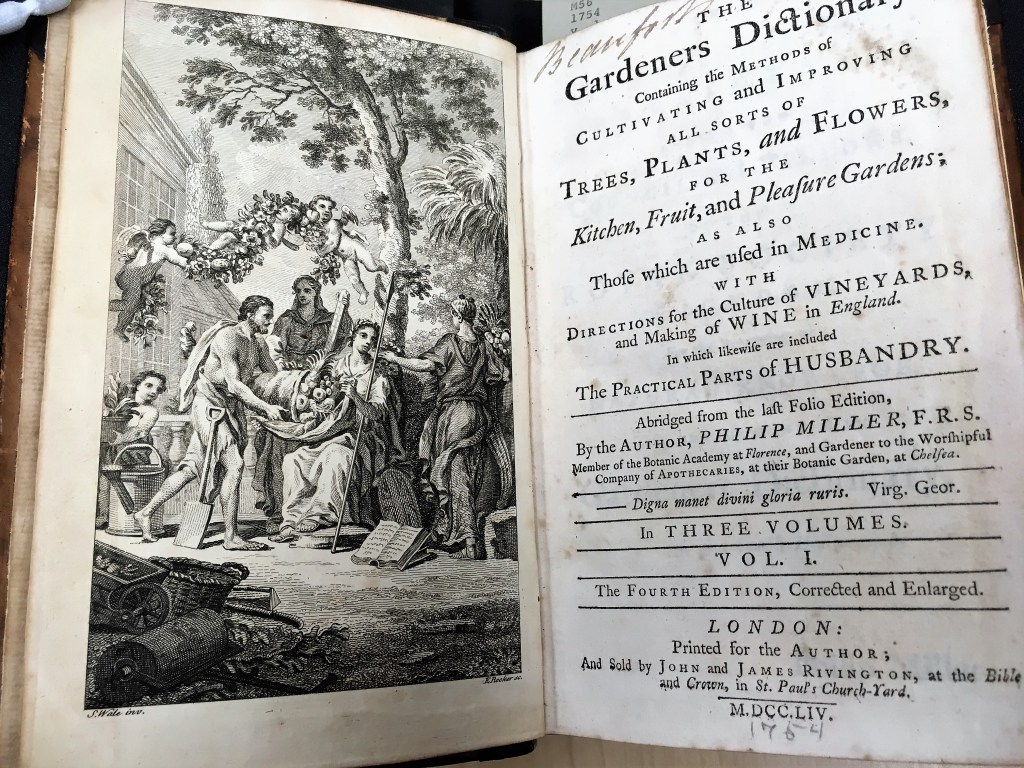
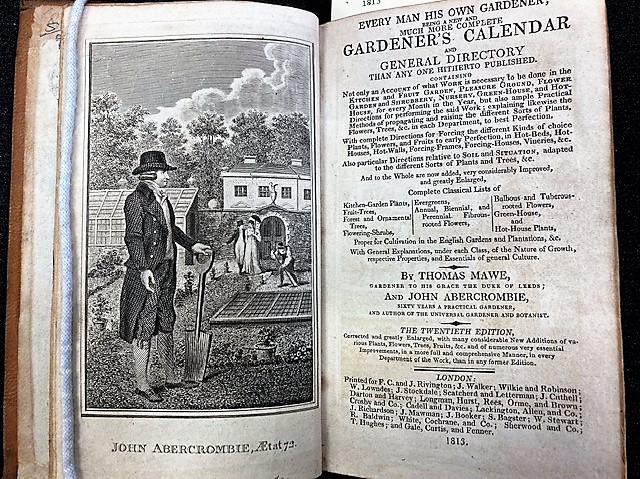
If Jane Austen’s brother, Edward Austen Knight, is any indication, owners of estates like Mr. Knightley would have a collection of books about gardening and farming in their library for reference.  The 1818 catalogue of the Knight library, which is now searchable at https://www.readingwithausten.com/catalogue.html, lists several gardening and botany books from the eighteenth and early nineteenth century that were popular and went through many editions.  Some of the Knight gardening books are organized by type of plant, such as John Evelyn’s Sylva or John Abercrombie’s The Universal Gardener and Botanist (UGB, 1778 first edition)[i]; others are organized by months of the year to describe what work needs to be done in each part of the garden, such as Philip Miller’s Gardeners Kalendar (GK, 1732 first edition); and others focus on methods for propagating and growing plants, such as William Marshall Planting and Ornamental Gardening (1785 first edition) and Abercrombie’s The Propagation and Botanical Arrangements of Plants and Trees (1784 first edition)Other popular gardening books I consulted that are not in the Knight collection are Miller’s Gardeners Dictionary (GD, 1754 edition at MASC), Abercrombie’s Every Man His Own Gardener (EMOG, 1813 edition), which is another gardener’s calendar, and John Loudon’s An Encyclopaedia of Gardening (1822 edition online and 1826 edition at WSU MASC; 1835 reprint edition), which summarizes the knowledge of over 100 gardening books from the 1700s and early 1800s.  All these books are available online through Google books, and I studied original versions (although usually a different edition) of several of the books at the Washington State University Manuscript, Archives & Special Collections library (see photographs of the MASC books in Illustration Section 1 and the Works Cited list for links to the online versions).  These 18th and 19th century books can give us a sense of what was involved in raising fruits and vegetables in Austen’s time.

Illustration Section 1: English Gardening Books from Early 1800s and 1700s

Pictures taken at Washington State University Manuscripts, Archives & Special Collections (MASC) by Michele Larrow

Fruits and Vegetables Mentioned in Austen’s Letters and Works[ii]

Before I describe the kitchen garden and orchard, I will review some of the ways fruits and vegetables are mentioned in Austen’s letters and works.  Fruits or vegetables, along with other foods, are sometimes used in the story’s context to show the moral failings of a character (see Lane 90-100). Dr. Grant and Mrs. Norris’s argument about the apricot tree, with Dr. Grant’s insult that “these potatoes have as much flavor of a moor park apricot, as the fruit of that tree” (MP I, 6, 94)  and Mrs. Norris’s angry defense that the cost to Sir Thomas was “seven shillings, and [it] was charged as a moor park” apricot tree (I, 6, 93), show his selfish gourmand neglect of other people’s feelings and her money-focus and seeking power through Sir Thomas.  In Northanger Abbey, when General Tilney’s asks Catherine about Mr. Allen’s “succession-houses” and feels “self-satisfaction” when told Mr. Allen did not care about the garden, along with General Tilney’s complaint-brag that his “pinery had yielded only one hundred in the last year” of very-expensive-to-grow pineapples, are all signs of his greed and relentless focus on social comparison (II, 7, 256, see Wolfson’s note 18; also, Lane 95).  While waiting to pick up Lizzy and Jane at an inn, Lydia Bennet’s extravagance and thoughtlessness is shown when she orders “cucumber and sallad” (sallad would mean just lettuce, Lane 65) without having the money to pay for it—cucumbers were quite expensive because they were grown in hot frames, especially for May (PP II, 16, 258, see Spacks note 5).  Austen also notes in a letter from Bath that a cucumber will be a “very acceptable present” because it cost 1 shilling (5-6 May 1801). In Sanditon, Mr. Parker’s willingness to leave his ancestral estate and his complaints about the “Eyesore of [the Kitchen Garden’s] formalities; or the yearly nuisance of its decaying vegetation.–Who can endure a Cabbage Bed in October?” in spite of his wife’s obvious “fondness of regret” (MW 380) for the old home show his lack of attention to other’s feelings as an “Enthusiast” seeking to develop Sanditon (371).  Of these examples, General Tilney and Dr. Grant are the most morally deficient because they “render the atmosphere in their homes unpleasant” (Lane 93).

Emma is all about eating and growing food and has several characters who reveal themselves through their discussion of food.  Mr. Elton’s excessively detailed description of dinner at the Coles to Harriet, with “the Stilton cheese, the north Wiltshire, the butter, the cellery, the beet-root and all the dessert” shows his self-absorption (and lack of romantic interest in Harriet; I, 10, 122; also Lane 91).  Mrs. Elton “monopolizing the conversation” (LeFaye 96) while strawberry picking at Donwell shows her desire to dominate and be seen as knowing everything:

‘The best fruit in England . . .–These the finest beds and finest sorts. . . .–Hautboy infinitely superior . . .– Chili preferred—white wood finest flavour of all—price of strawberries in London—abundance about Bristol—Maple Grove—cultivation—beds when to be renewed—gardeners thinking exactly different—no general rule—gardeners never to be put out of their way—delicious fruit—only too rich to be eaten much of—inferior to cherries—currants more refreshing—only objection to gathering strawberries the stooping—glaring sun—tired to death—could bear it no longer—must go and sit in the shade.’”

Emma (II, 6, 406)

Mr. Woodhouse is in his own class in seeking to control what others eat:  his “gentle selfishness and being never able to suppose that other people could feel differently from himself” (I, 1, 33) leads to his depriving poor Mrs. Bates of “asparagus and sweetbreads” (as reported by Miss Bates; III, 2, 372), or offering guests “a little bit of tart, a very little bit. Ours are all apple tarts” (I, 3, 54).  He wants the Bates’s to cook their apples “three times” (II, 9, 277) and hopes that the ham that was gifted from Hartfield will be “eaten very moderately of, with a boiled turnip and a little carrot or parsnip” (II, 3, 208).  Although there is humor in his portrayal, Mr. Woodhouse is a poor host who intellectually is unable to consider other people’s true needs and desires.  In these examples from Emma, Austen uses the characters’ interactions around food to show that they are inherently self-centered and contrasts with the true charity of other characters.

Fruits and vegetables can be special gifts of generosity and hospitality that reflect the giver’s moral worth and bring joy to the recipients.  In Emma, Miss Bates learns from William Larkins (Mr. Knightley’s steward) that Mr. Knightley gave them “all the apples of that sort his master had; he had brought them all” (II, 9, 278), so that Mr. Knightley deprives himself of apples for the rest of the spring.  Generous Miss Bates invites all her guests (Emma, Harriet, Frank, and Mrs. Weston) to share in the baked apples in that same chapter.  In her letters, Austen tells Cassandra with delight about receiving “two hampers of apples” from the Fowle family at Kintbury (24-25 October 1808) and asks her nephew to thank his father (James) “with love” for the “Pickled cucumbers” he sent (16-17 December 1816).  Mr. Darcy and Geogianna serve “beautiful pyramids of grapes, nectarines, and peaches” (PP III, 3, 309) to Elizabeth and Mrs. Gardiner, an elegant and welcoming treat for their guests.  Sometimes, however, the gift of food fails to comfort, as when young Fanny Price misses home so much that she is not able to eat “two mouthfuls” of the “gooseberry tart” (MP I, 2, 53) without crying and good-natured Mrs. Jennings attempts to soothe Marianne’s broken heart with “dried cherries” (SS II, 8, 237) and “Constantia wine” are rejected, although Elinor drinks the wine instead, reflecting that “its healing powers on a disappointed heart might be as reasonably tried on herself as on her sister” (II, 8, 242; Spacks note 13 says Constantia is a sweet dessert wine made with Muscat grapes). 

In Austen’s letters, and occasionally in the novels, fruits or vegetables are mentioned in more everyday ways as items grown in the garden or near the house, parts of housekeeping, or food eaten.  One of the rare mentions of a pear occurs in Persuasion: “the compact, tight parsonage, enclosed in its own neat garden, with a vine and a pear-tree trained round its casements” (I, 5, 74; “vine” by itself refers to grape vines in that period, see Abercrombie, EMOG 173). In letters to Cassandra, she mentions plans for the garden or the state of the plants: at Steventon “apples, pears, and cherries” are planned (20-21 November 1800) and “Grapes . . . must be gathered as soon as possible” (27-28 October 1798); at Southampton “currant and gooseberry bushes, and . . . raspberries” are planted (8-9 February 1807); while at Chawton, she discusses the number of “Orleans plumbs [and] . . . greengages” (29 May 1811) and “pease,” “strawberries,” “gooseberries,” and “currants” (6 June 1811).  Gardens do not always go as planned, producing one of Austen’s funniest lines in a letter: “I will not say that your Mulberry trees are dead, but I am afraid they are not alive.” (31 May 1811).  The growth of the garden and its produce is enjoyed by Austen in Chawton, probably especially after living in Bath.

Many of Austen’s letters to Cassandra mention food that was served or eaten.  Austen was the deputy housekeeper when Cassandra was away and her mother indisposed so she reports to Cassandra about serving “pease soup” (1-2 December 1798) and “haricot mutton” (17-18 November 1798; Lane shared a 1782 haricot mutton recipe for a stew containing mutton, carrots, turnips, celery, asparagus, cabbage, and cayenne but no beans, 60).  Sometimes the housekeeping duties are too much–Austen complains after guests have left Southampton about “the torments of rice pudding and apple dumplings” (7-8 January 1807).  While at Godmersham, Austen asks Cassandra if their Chawton garden has the fruit that she is enjoying such as “Tomatas . . . [which] Fanny & I regale on” daily (11-12 October 1813); and when living in Southampton, she writes “I want to hear of your gathering strawberries, we have had them three times here” (20-22 June 1808).  Endearingly, when Austen enjoyed “Asparagus & a lobster” at an inn on the way the Bath with her brother Edward’s family, she “wished for” Cassandra to be there too (17 May 1799).  While Mrs. Jennings description of eating mulberries from the tree on Colonel Brandon’s estate is seen as somewhat vulgar “Lord! how Charlotte and I did stuff . . .” (SS II, 8, 240) and in the topsy-turvy world of “The Visit”, there is humor in the refined guests feasting on common foods such as “fried Cowheel and Onions,” “Elder wine,” and “Gooseberry Wine” (J 66-67; Sabor notes on 413 that cowheel and onions is “a coarse dish consumed by labourers”; also Lane 80), Austen clearly enjoys everyday foods, especially fruit: “Good apple pies are a considerable part of our domestic happiness” (17-18 October 1815).

The Kitchen Garden 

Kitchen Gardens were quite large on estates since they had the land, and it was much cheaper to grow your own food.  When the Austen family lived at Steventon, they were largely self-sufficient for food between their kitchen garden and orchards, poultry and dairy, and farm crops (LeFaye 48; Wilson 1).  The famous eighteenth century horticulturalist and botanist, Philip Miller (GD Vol. II, “Kitchen Garden”) recommended 1 acre (about 3/4s of a football field) for a small family (which includes servants, see Lane 144) and 3-4 acres (about 3 football fields; see Video 2 of Hillsborough Castle for a 4-acre walled garden) for a large family, built on one side of the house, near the stables (for dung) and near water.  Abercrombie writes that a kitchen garden of about an acre can be cared for by one gardener and larger gardens would need more help (UGB “Kitchen Garden”).  The kitchen garden would have square or rectangular beds divided by walkways.  Miller suggested surrounding the garden with a 12-foot wall for training fruit trees and to keep out animals that would eat the food.  The area within the wall would have a wide dirt border (about 12 feet) to support the wall-trained trees.  There was also space for glass-topped frames for growing melons and cucumbers that need protection from the cold. Nursery beds are sheltered beds where seedlings and cuttings could grow, often spaced more closely together than how they will grow when transplanted in their permanent spot.  Loudon (1826 edition) gives an example of a kitchen garden design and diagrams the parts, as seen in illustrations 4.1 and 4.2 below.  In Video 1 of Walmer Castle and Video 2 of Hillsborough Castle, there are several aerial shots over the kitchen gardens so you can see the scope of them (see the end of the blog text for the video links). 

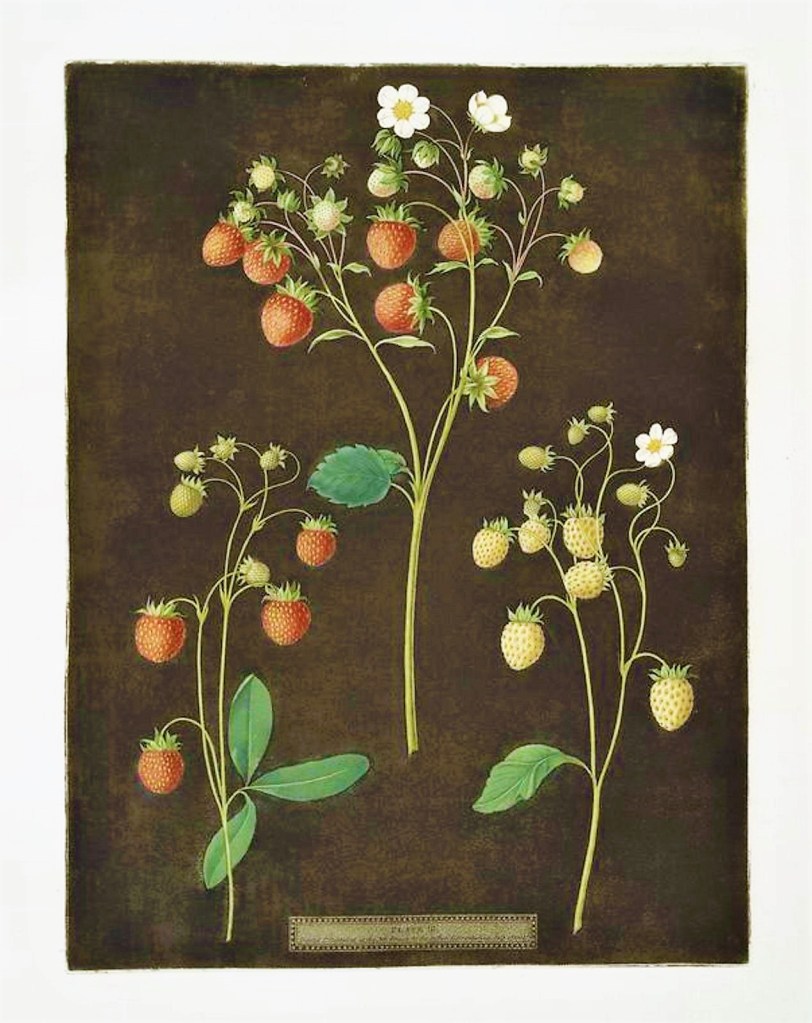
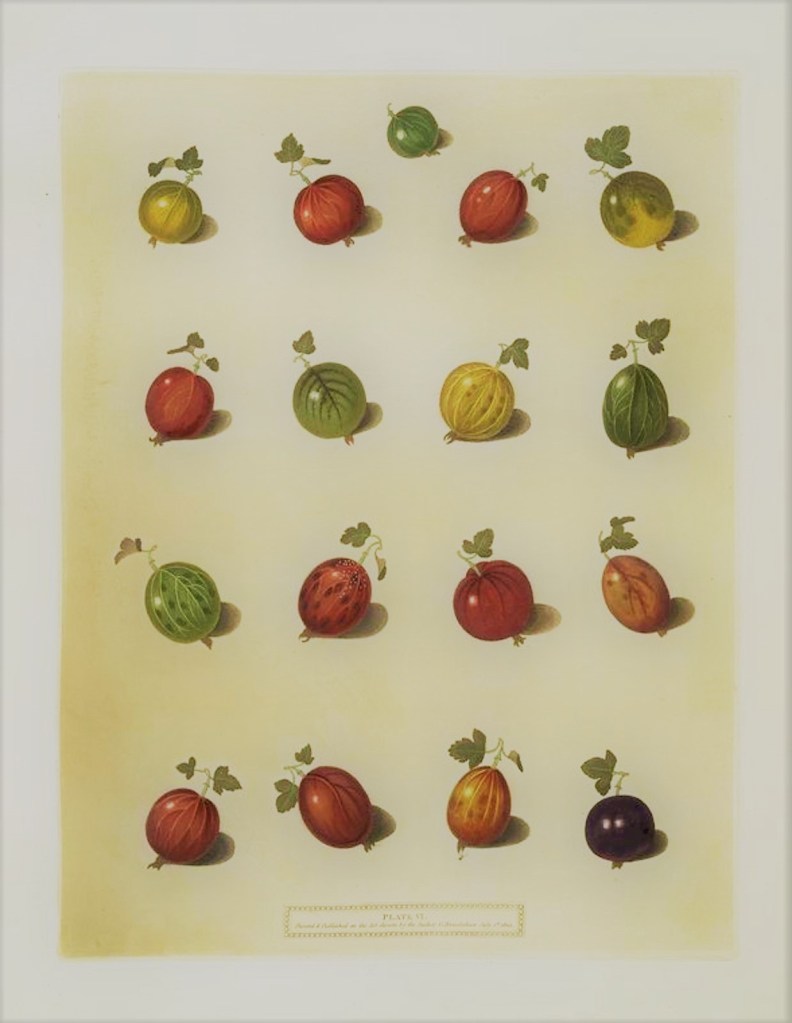
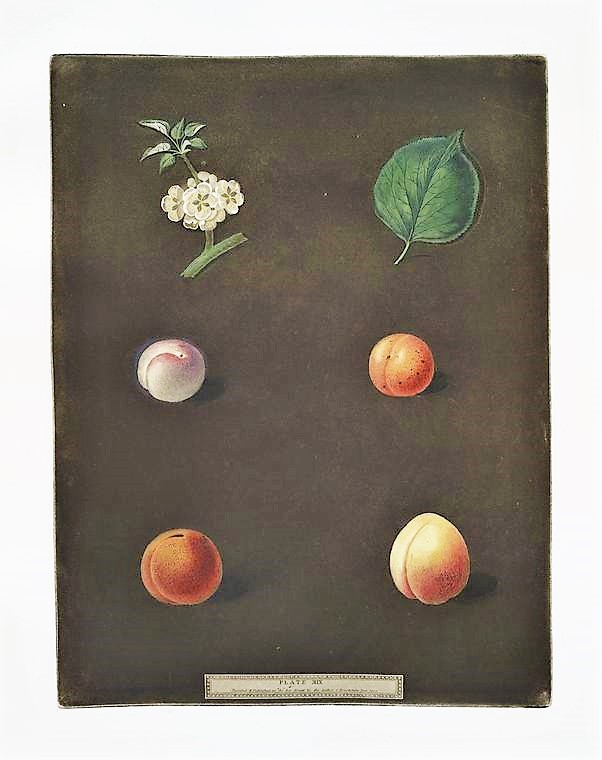
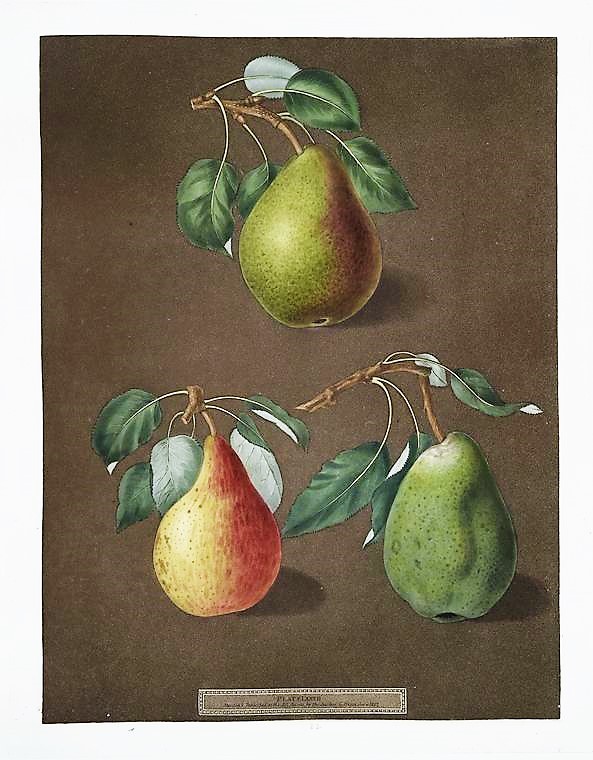
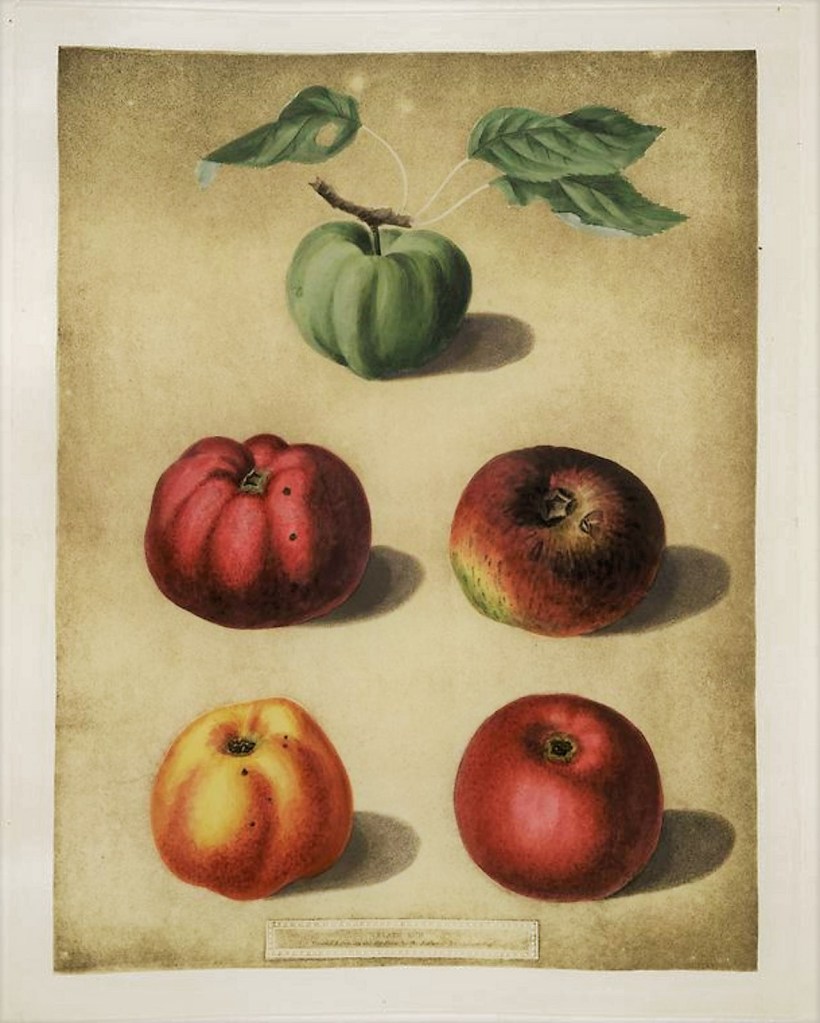
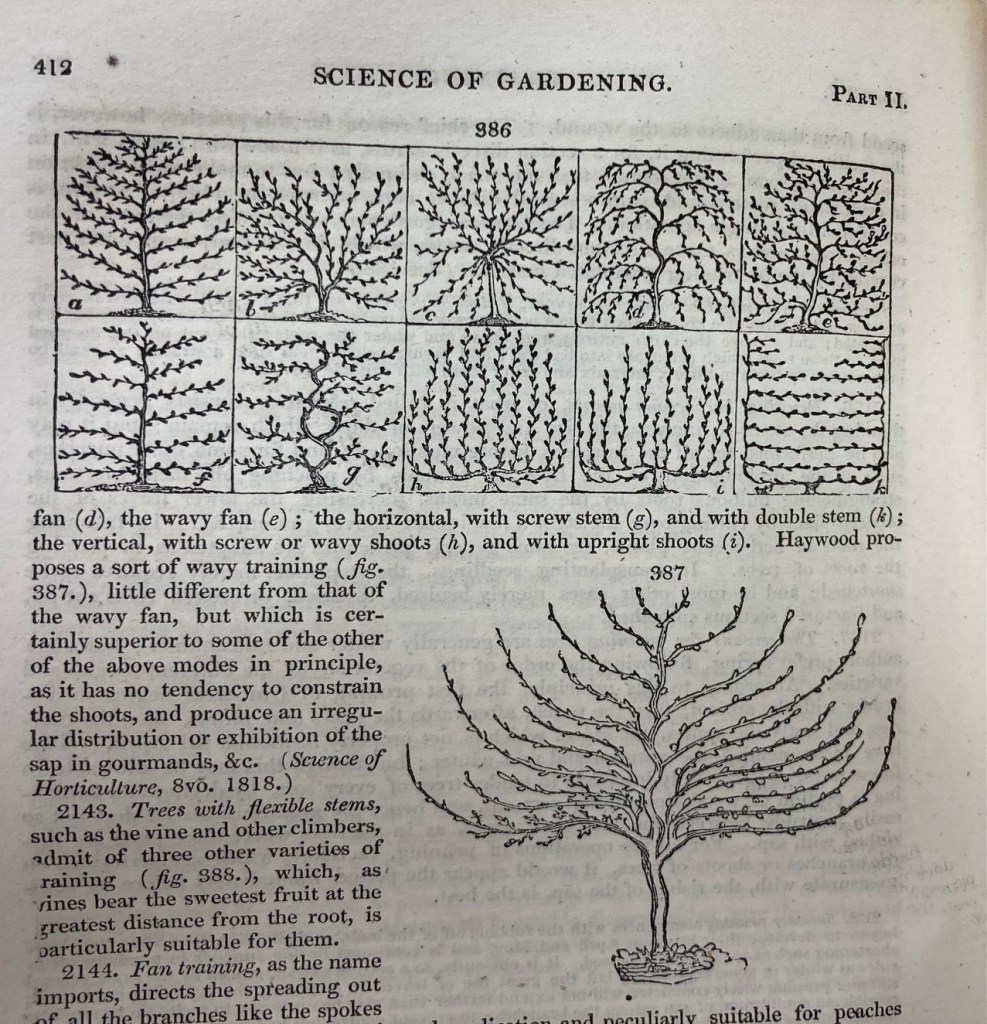
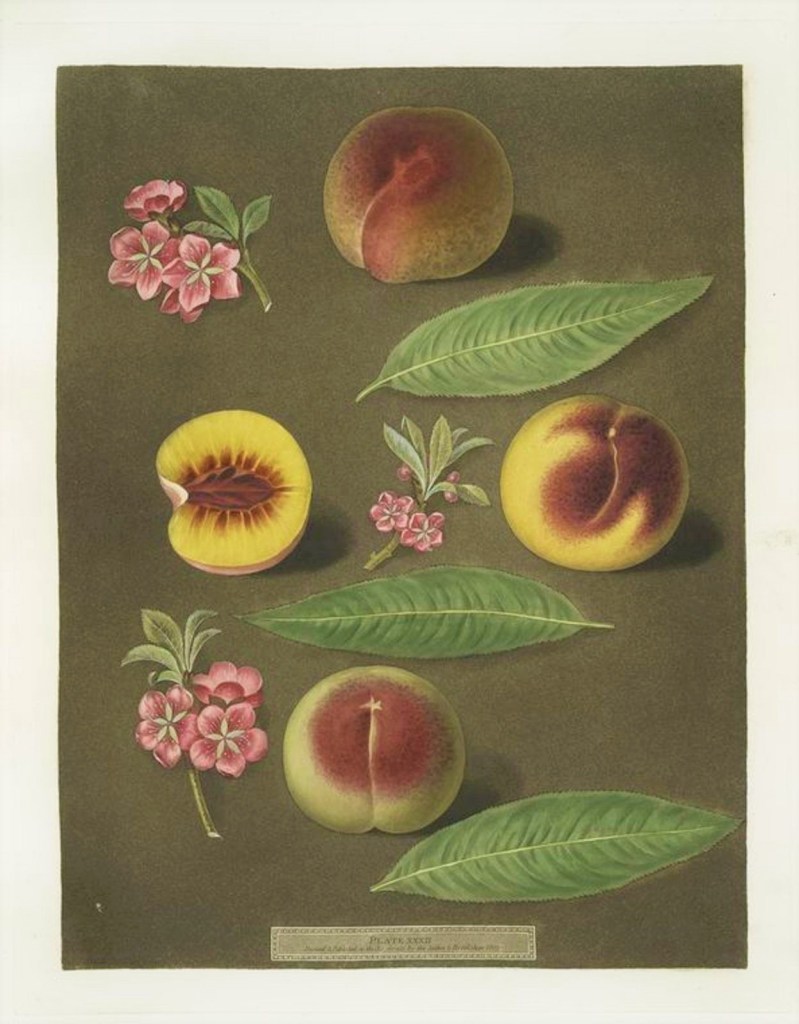
Colonel Brandon’s estate Delaford is described by Mrs. Jennings as “quite shut in with great garden walls that are covered with the best fruit trees in the country” (SS II, 8, 240) and Donwell Abbey’s kitchen garden was probably very similar. Fruit trees that are trained against the south-facing garden wall have a more protected and warmer growing environment for earlier blooming or more cold-sensitive fruit.  Trees grown on the north-facing walls would be somewhat later blooming and bear fruit later, to prolong the fruit’s season (Miller, GD Vol. 2“Kitchen Garden”).  Almost every fruit tree mentioned in Austen’s works or letters could be trained against garden walls (at least in the southern English counties) include apples, pears, plums, cherries, apricot, peaches, nectarines, and grapes (the last three fruits are in Pride and Prejudice, where they would have been grown in forcing houses since Derbyshire is so far north—see my prior blog https://jasnaewanid.org/2022/07/30/mr-darcys-fruit/ ).  Fruit trees such as apples and pears trained onto garden walls or espalier (trained on fences as Robert Martin’s apple trees are in Emma II, 5, 224)[iii] would be pruned into a single flat layer of branches growing horizontally from the trunk of the tree, about 4-6 inches apart and allowed to grow to full length (Abercrombie, EMOG; Miller, GD Vol. 3 “Training”) and stone fruits would be trained into a fan pattern (Loudon 1835 668-671; see below for illustration 4.3 for pruning shears, 4.6 for an iron espalier rail, and 4.7 for training patterns from the 1826 edition).  Figs are also wall-trained although they can grow as standards (Loudon, 1835 959).  Gooseberries and currants grow on bushes, often trained as “standards” with a single stem topped by several branches with fruit and might line walkways in the kitchen garden about 6-10 feet apart (Loudon, 1835 743; Miller, GD Vol. II “Kitchen Garden”). Raspberries, a native of Britain, usually are grown as shrubs best planted in a shadier spot of the garden, although they are also used to line walkways (Loudon 1835 935-937).  Mulberries were sometimes trained against kitchen garden walls but more often would be a stand-alone tree, as it appears to have been at Delaford since Mrs. Jennings described it as “such a mulberry tree in one corner!” (SS II, 8, 240), either placed in the kitchen garden (especially in the 1700s), in the pleasure grounds, or in the orchard.  Mulberries take several years to produce fruit and can live to an old age still producing (Loudon, 1835 927).  Strawberries would be grown in beds in the kitchen garden, planted in rows a foot apart with plants spaced from 8-24 inches apart depending on the size of the strawberry variety (Miller, GD Vol. 1, “Fragaria”).   George Brookshaw’s Pomona Britannica (1812) has beautiful illustrations of many fruits, showing the many varieties especially of strawberries, gooseberries, cherries, apricots, plums, peaches, nectarines, grapes, pears, and apples, as well as the currants and raspberries, which just have two or three varieties (see Section 2 for a selection of the plates).

Illustration Section 2: Fruits from George Brookshaw’s Pomona Britannica

Illustration Credits list the exact fruit pictured and give a link for the digital copy

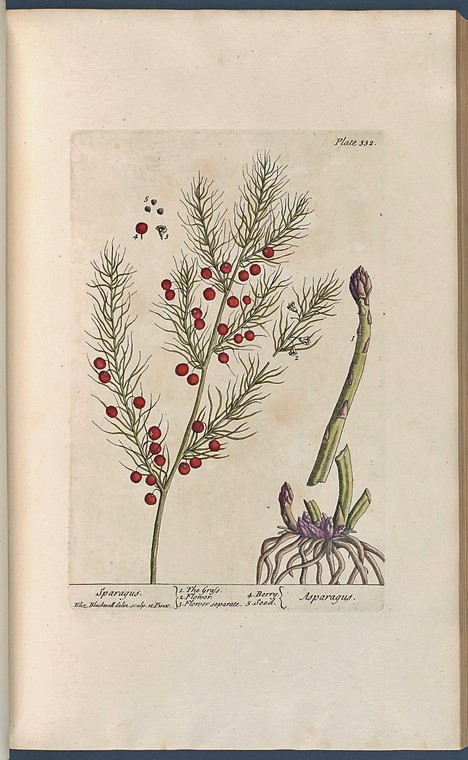
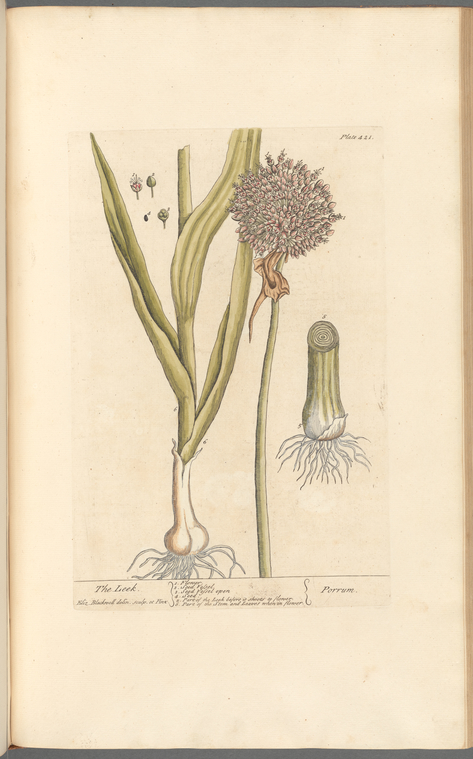
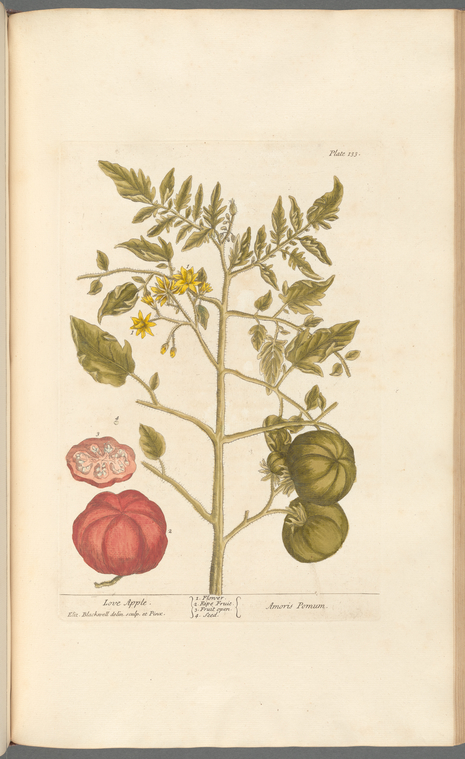
There would also be a large variety of vegetables grown in the kitchen garden.  Austen’s family grew peas, tomatoes, and potatoes at Steventon and Chawton (Wilson 4, 46 and LeFaye 21, 248).  Other vegetables mentioned in Austen’s works and letters that would be in the kitchen garden include celery, cucumber, beets, cabbage, carrots, turnips, onion, parsnip, and asparagus.  Also grown in the kitchen gardens at the time, though not mentioned by Austen, are broccoli, cauliflower, artichokes, leeks, radish, beans, hot peppers, and many herbs (see Miller, GD and Abercrombie, EMOG).  Most of the vegetables would be grown from seed and planted annually; Miller recommends changing where the plants are grown in the garden each year (GD Vol II “Kitchen Garden”).  Loudon discusses the rotation of vegetable and some fruit crops in more depth: recommending annual rotation of the “brassica tribe [cabbage family], the leguminous family, the tuberous and carrot-rooted kinds, the bulbous or onion kinds; and the lighter crops, as salads and herbs” (Loudon, 1835 749).  Strawberry beds should be renewed every 4-5 years. Artichokes, asparagus, currants, gooseberries, and raspberries should be renewed every 7-8 years (Loudon, 1835 748-749).  To maximize the length of time that specific vegetables were available fresh, the vegetables grown from seed would be sown at regular intervals many times through the growing season, such as lettuce, celery, peas, beans, carrots, radishes, etc. (Abercrombie, EMOG) starting as early as January and lasting through December (Loudon, 1835 1245-1260).  Asparagus is started as a seed, but the roots do not produce stalks until after 3 years; the stalks come up annually after that and are best when harvested in May and June (Abercrombie, UGB “Asparagus”). Vegetables such as celery, asparagus, and endive would be grown using a process called “earthing” where the stalks are covered with earth to keep the vegetable “white, tender, and palatable” (UGB “Apium”).  Other vegetables like potatoes would be planted in March or April from chunks of potato with one or two eyes and then harvested in the fall (Abercrombie, EMOG 37, 159).  Elizabeth Blackwell’s A Curious Herbal, originally published in 1737-39, has illustrations of several vegetables grown in the kitchen garden (see Illustration Section 3).

Illustration Section 3: Vegetables from from Elizabeth Blackwell’s A Curious Herbal

Illustration Credits list the vegetable pictured and give a link for the digital copy

Orchard

Mr. Wentworth, Mrs. Croft and Captain Wentworth’s clergyman brother, is described thus by Sir Walter’s lawyer, Mr. Shepard: “came to consult me once, I remember, about a trespass of one of his neighbours; farmer’s man breaking into his orchard—wall torn down—apple stolen—caught in the fact; and afterwards, contrary to my judgment, submitted to an amicable compromise.”

Persuasion I, 3, 59

Since orchards have large trees, they can produce a great deal of fruit that is valuable for both home baking and dessert eating and for sale (and potentially pilfered, as Mr. Wentworth found in Persuasion).  We know in Emma that Mr. Knightley sells most of his apples when he tells Miss Bates, as reported by her, that “William Larkins let me keep a larger quantity than usual this year” telling her a white lie to convince her to accept his gift of apples (II, 9, 278).  At the strawberry picking party, the “orchard in blossom” that Emma sees looking down to Abbey-Mill Farm, Robert Martin’s prosperous farm that he rents from Mr. Knightley, is seen as one of Austen’s few mistakes in facts, since orchards usually bloom in May (III, 6, 409).  Austen enjoyed orchards for both their beauty and utility; in a letter to Cassandra from Chawton, she tells her “You cannot imagine, it is not in Human Nature to imagine what a nice walk we have round the Orchard” (31 May 1811).

Philip Miller recommended that orchards be situated on gently rising ground (not a hill) open to the southeast so that trees are exposed to the right amount of “the Sun and Air” (GD Vol. II, “Orchard”).  He also prefers that the trees be defended from winds from the west, north, and east and that a screen of timber trees be planted around the orchard if it is not naturally protected by hills.  Trees should be planted “fourscore [80] feet asunder not in regular rows.” Wheat and other crops can be planted between the trees in order to plow and till the soil, which makes the trees “more vigorous and healthy”.  Miller focuses on stone fruit, apples, pears, and cherries in the orchard.  Trees should be planted in the spot they will stay in when young and been previously raised in similar soil to the orchard in the nursery bed.  Once the trees are established, they should only be pruned to take off dead branches.

In The Gardener’s Encyclopaedia, John Loudon summarizes several different gardeners’ writings on orchards, saying that they can be between 1 and 20 acres, depending on land and demand for the fruit (1835 744-746). Alternatively, large fruit trees can be distributed among the ornamental plantings on an estate.  Hardy fruits such as apples, pears, cherries, plums, medlar, mulberry, quince, walnut, chestnut, filbert, berberry make for a complete orchard.  If fruit is grown for sale, “apples are first in utility” and pears, cherries, and plums “are acceptable” for cooking with (1835 744).  Orchards are best planted in the autumn and Loudon recommends that trees be spaced about 30-40 feet apart.

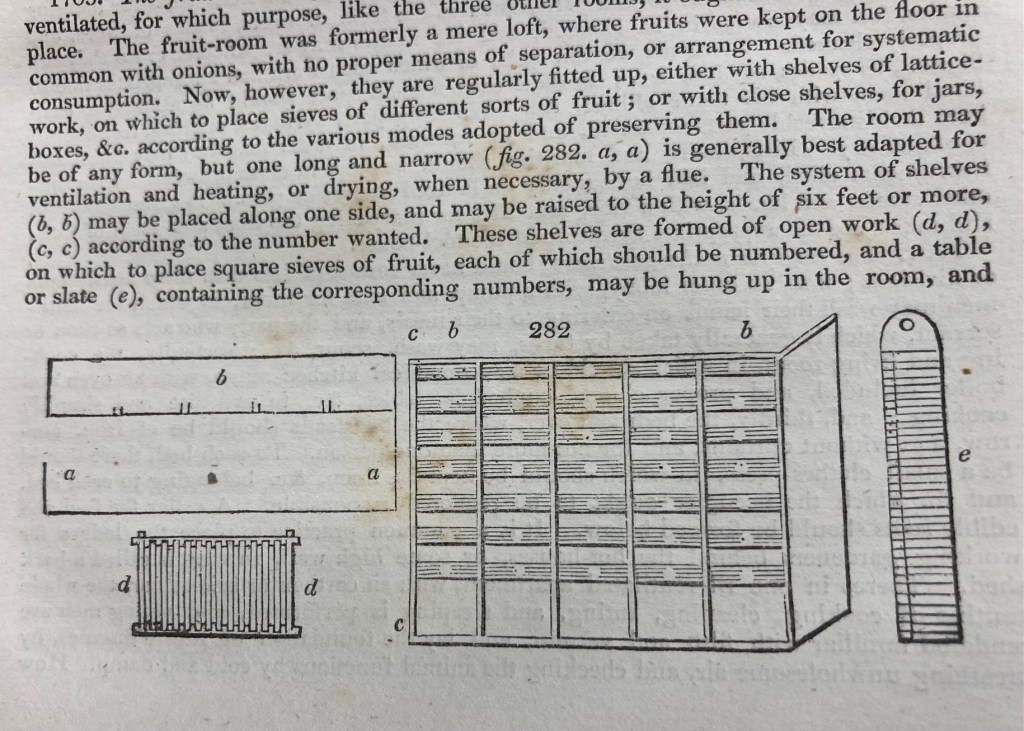
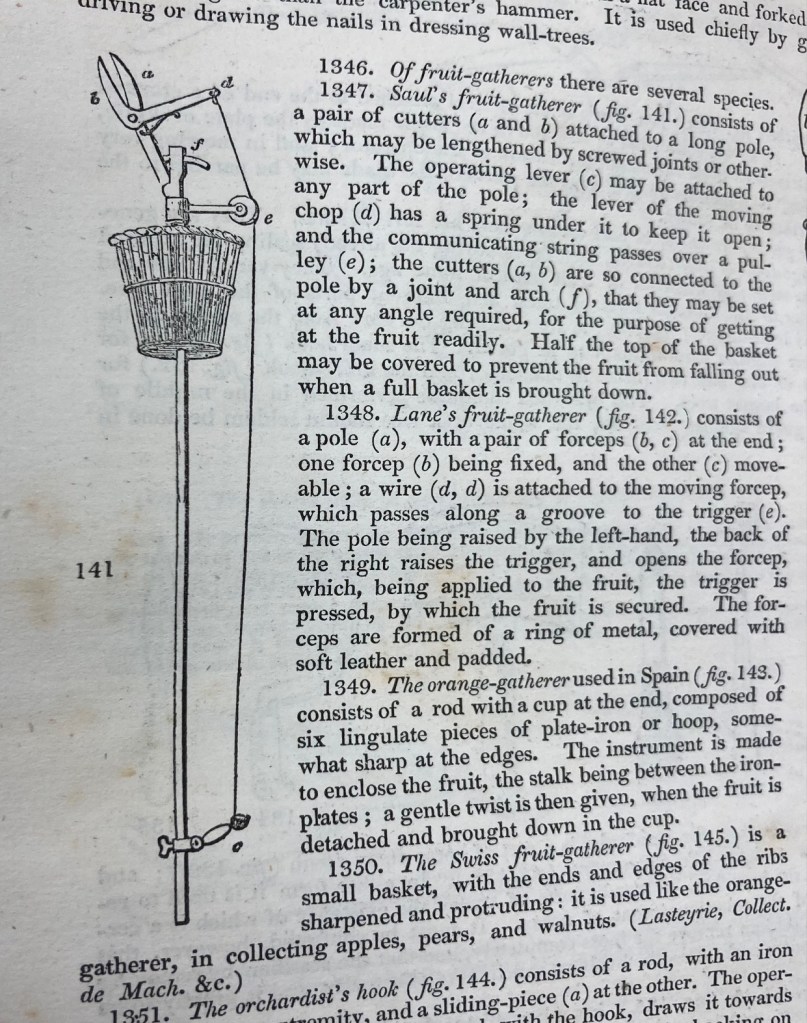
We wrote in a previous blog https://jasnaewanid.org/2022/06/04/pomona-britannica-and-emma/ that apples and pears had hundreds of varieties in the 1700 and 1800s, some varieties would  ripen in mid-summer and others in late fall/early winter and then would finish ripening off the tree in storage, to ensure almost a year-round supply of the fruit (especially of apples).  Miss Bates says of Mr. Knightley’s apples “there never was such a keeping apple anywhere as one of his trees—I believe there is two of them. My mother says the orchard was always famous in her younger days” (E II, 9, 278).  Orchard tree fruit should be picked by hand (using ladders or using a fruit gatherer, like illustration 4.4) to keep it as unblemished as possible—windfalls and those shaken down are liable to bruise and spoil easily.  According to Miller (GD Vol II “Malus”), late ripening apples should be left on the tree as long as possible (until frost) and then picked in dry weather, sweated in piles for 3-4 weeks, wiped dry, and stored in large oil jars.  Jane Austen stored her “two hamper of apples” from Kintbury on the floor of the “garret” when living in Southampton to keep them cold (24-25 October 1808).  Larger estates would have fruit rooms with regulated temperature where fruit was kept on shelves of open lattice for air circulation, which also allows easy access to take out the fruit for consumption throughout the winter (Loudon, 1835 760 and illustration 4.5).  Apples and pears for keeping would be stored in jars or barrels in the temperature controlled (32℉ to 40℉) fruit cellar and not opened until needed in the spring, lasting into May or June (Loudon, 1835 759-761). With careful management, apples and pears could be eaten year-round.

Illustration Section 4: Illustrations from An Encyclopaedia of Gardening by John C. Loudon, 1826 edition

Pictures taken at Washington State University Manuscripts, Archives & Special Collections (MASC) by Michele Larrow. The book was propped to preserve the spine so the pictures are not flat. For 4.2 Diagram of a Kitchen Garden a=slips, b=walls c=walks, d=quarters (beds), e, h, k=rooms, f=compost & hot-beds, g=gardener’s house, m=fountain/water, p=open railing, q=irregular borders

June in the Kitchen Garden and Orchard

In the 1700 and 1800s, there were several calendars for gardeners that helped them to keep track of what needed to happen when in the gardens.  Philip Miller’s Gardeners Kalendar was owned by Austen’s brother Edward.  John Abercrombie’s Every Man his Own Gardener gives even more details about the work that needs doing than Miller’s Kalendar.  Miller offers us a list of the fruits that would be ripe in June, such as strawberries, currants, gooseberries, cherries (trained on walls) and in forcing houses peaches, nectarines, and grapes.  He also notes that “carefully preserved” keeping apples such as Golden Russet and Stone Pippin, would still be good (GK 187).  The vegetables available in the kitchen garden would be cauliflower, cabbage, young carrots, beans, peas, artichokes, asparagus, turnips, cucumbers, salad herbs, some celery, and melons (GK 183).  Because of the protection of the kitchen garden walls, much produce would be available as early as June.

In the June Kitchen Garden, Abercrombie recommends constant weeding and watering when plants are dry.  Beets, onions, carrots, and parsnips are to be thinned. Lettuce, peas, turnips, and cabbage can be first planted or sown again for use later in the summer (lettuce and peas) and in the fall and winter (turnips and cabbage).  Celery would be planted at different times for a continuous supply over the summer and earthing (packing dirt around the base) takes place in June.  Asparagus stalks should not be cut after June 24th to keep the roots strong.  Cucumbers would be grown in frames and were sown in January and February for summer consumption.  On June days, the frames would be opened to allow air and they would be shaded from the sun during the hottest parts of the day (EMOG 1787 283-300). 

For the fruits in the Kitchen Garden, in May and June wall-fruits such as apricots, peaches, nectarines, apples, pears, cherries, and plums should be thinned, taking off many of the fruits and only leaving those that are the best shape and the biggest (and only as many as the size of the branch can support).  The young fruit that is taken off can be used for tarts.  Additionally, the fruit trees need to be pruned of shoots that are not productive to fruit either this year or next.  Grapes vines should be pruned in May and June of all shoots that are weak or non-productive.  The strawberry beds produce runners in June that can be planted for next year (or even for the winter if planted in frames; Abercrombie, EMOG 1787 252-253, 301-307). 

Conclusion

An incredible amount of labor went into producing food in Jane Austen’s time.  Mr. Knightley would undoubtedly have at least one gardener to work in his garden, separate from William Larkins, who functions as his steward, managing the estate, including going over the books with him.  The gardens involve numerous tasks in every month of the year, whether it is pruning hardy fruit trees in January, planting seeds and bulbs in March, destroying insects in May, sowing autumn vegetables in July, planting cuttings of shrub-fruits in September, or storing late fruit in November (see Loudon, 1835 1243-1260 for a short Kalendarial Index).  The goal in the kitchen gardens was to have fresh fruit and vegetables as early as possible and lasting as long as possible through the year.

In our next blog, I will cover the pleasure grounds, including flower beds, shrubbery, ornamental woods, as well as the growth of trees for sale as timber.  I will also discuss the use of greenhouses and hot-houses for growing cold sensitive plants in that blog.

Videos

These videos all show examples of walled kitchen gardens on large estates in the British Isles.  Thanks to region member Sara Thompson for video suggestions. 

Video 1: https://youtu.be/WE2kkFMTFIY  Walmer Castle Kitchen Garden (about 4 minutes)Spring in the walled kitchen garden with espalier trees, beans, asparagus, strawberries, cold frames.

Video 2:  https://youtu.be/aLu_P69ZkuI Hillsborough Castle Walled Garden Autumn Harvest (about 4 minutes; Northern Ireland British Royal Palace) 4-Acre Walled Garden with espalier pear trees; shows lots of vegetables also.

Video 3: https://youtu.be/vop2ZpK7fbY  Audley End House Kitchen Garden in Spring (about 14 minutes) Walled kitchen garden that includes espalier apples in bloom, potting tomatoes, a peach house and a vinery.

Video 4:   https://youtu.be/ssAoqhrVT28 Audley End House Kitchen Garden: Picking Apples in Fall (about 11 minutes) Picking apples growing in the walled garden on espalier wires and walls.  Although this video is described as gardening practices in the Victorian era, the advice about how to pick the apples is the same as what was written in the 1700s and early 1800s.


NOTES

[i] The title page of several of Abercrombie’s works lists Thomas Mawe as the first author, but in fact he did not contribute to the works (see introduction to the EMOG book and the title listing of the 11th edition in WORKS CITED), so I am listing Abercrombie as the sole author for EMOB and UGB.

[ii] The Belknap Press of Harvard University Press editions of the six novels were used for reference (NA=Northanger Abbey, SS=Sense and Sensibility, PP=Pride and Prejudice, MP=Mansfield Park, E=Emma, and P=Persuasion).  These editions have excellent annotations often with illustrations about gardening, food, and landscaping, as well as other topics.  For ease of comparison to other editions, I have included the Volume and Chapter of each quotation, as well as the page number in the edition used.  See the Works Cited section for the specific editions used of the Minor Works (MW) and Juvenilia (J).  For Jane Austen’s Letters (L), I used the Diedre Le Faye 3rd Edition, 1995 and am indebted to the wonderful searchable index of subjects for that edition created by Del Cain in 2002 and available at:  https://www.mollands.net/etexts/ltrindex/index.html.

[iii] The term “espalier” was used in the 1700s and early 1800s only to refer to fruit trees that are trained against rails or fences into a flat pattern.  Fruit grown against walls would be called “wall trees”, see for example Loudon, 1835, 1252.  In current usage, espalier refers to 1. a tree that is trained to grow into a flat pattern against a wall or other supports or 2. the supports itself (as a noun) and 3. the process of training the tree to grow in a flat pattern (as a verb; see dictionary.com).

ILLUSTRATION CREDITS

Illustration Set 2: Fruits

Most of the fruit illustrations are from George Brookshaw’s Pomona Britannica (1812).  Digital copies were color-enhanced to correspond to the prints available in George Brookshaw Pomona Britannica: The Complete Plates, Koln, Germany: Taschen, 2002.

2.1 Rare Book Division, The New York Public Library. “Wood strawberry – The new early prolific strawberry – White Alpine.” The New York Public Library Digital Collections. 1812. https://digitalcollections.nypl.org/items/510d47dc-8858-a3d9-e040-e00a18064a99

2.2 Rare Book Division, The New York Public Library. “Red and the White Antwerp Raspberries.” The New York Public Library Digital Collections. 1812. https://digitalcollections.nypl.org/items/510d47dc-8864-a3d9-e040-e00a18064a99

2.3 Rare Book Division, The New York Public Library. “Black currant – Dutch red and white currants.” The New York Public Library Digital Collections. 1812. https://digitalcollections.nypl.org/items/510d47dc-886a-a3d9-e040-e00a18064a99

2.4 Rare Book Division, The New York Public Library. “Sixteen varieties of Gooseberry.” The New York Public Library Digital Collections. 1812. https://digitalcollections.nypl.org/items/510d47dc-8876-a3d9-e040-e00a18064a99

2.5 Rare Book Division, The New York Public Library. “May-Duke, the White and Black-heart Cherries.” The New York Public Library Digital Collections. 1812. https://digitalcollections.nypl.org/items/510d47dc-887f-a3d9-e040-e00a18064a99

2.6 Rare Book Division, The New York Public Library. “Drap d’Or, or Cloth of Gold, White gage, Blue gage and Green gage plums.” The New York Public Library Digital Collections. 1812. https://digitalcollections.nypl.org/items/510d47dc-889c-a3d9-e040-e00a18064a99

2.7 Rare Book Division, The New York Public Library. “Royal Dauphin, Wine sour, Prune, Myrabolan and Carnation plums.” The New York Public Library Digital Collections. 1812.  [Note: These are apricots and are labeled incorrectly as “plums”] https://digitalcollections.nypl.org/items/510d47dc-88b6-a3d9-e040-e00a18064a99

2.8 Hooker, William. Pomona Londinensis: Containing Colored Engravings of the Most Esteemed Fruits Cultivated in the British Gardens : with a Descriptive Account of Each Variety. United Kingdom, W. Hooker, 1818. https://www.google.com/books/edition/Pomona_Londinensis/wDVKAAAAYAAJ?hl=en&gbpv=1, plate 9

2.9 Rare Book Division, The New York Public Library. “Red nutmeg, Hemskirk, Early Ann and French Vanguard Peaches.” The New York Public Library Digital Collections. 1812. https://digitalcollections.nypl.org/items/510d47dc-88c6-a3d9-e040-e00a18064a99

2.10 Rare Book Division, The New York Public Library. “Vermash, Violette Hative, Red Roman, North scarlet, Ell rouge and the Peterborough nectarines.” The New York Public Library Digital Collections. 1812. https://digitalcollections.nypl.org/items/510d47dc-88e9-a3d9-e040-e00a18064a99

2.11 Rare Book Division, The New York Public Library. “Black muscadine (grapes).” The New York Public Library Digital Collections. 1812. https://digitalcollections.nypl.org/items/510d47dc-8931-a3d9-e040-e00a18064a99

2.12 Blackwell, Elizabeth. A Curious Herbal… Engraved… by Elizabeth Blackwell…. United Kingdom, John Nourse, 1739/1751. Manuscripts and Archives Division, The New York Public Library. “The mulberry tree” The New York Public Library Digital Collections. 1751.  https://digitalcollections.nypl.org/items/19cfebd0-fcde-0136-5175-0d7952ce55cb

2.13 Rare Book Division, The New York Public Library. “Pears (Brown beurree, Golden beurree and the COlmar varities).” The New York Public Library Digital Collections. 1812. https://digitalcollections.nypl.org/items/510d47dc-899c-a3d9-e040-e00a18064a99

2.14 Rare Book Division, The New York Public Library. “Apples (White Colville, Red Colville, Norfolk Beefin, Norfolk paradise, Norfolk storing varities).” The New York Public Library Digital Collections. 1812. https://digitalcollections.nypl.org/items/510d47dc-8b7a-a3d9-e040-e00a18064a99

2.15 Rare Book Division, The New York Public Library. “Apples (Phoenix and the Norroway’s beauty varities).” The New York Public Library Digital Collections. 1812. https://digitalcollections.nypl.org/items/510d47dc-8b6a-a3d9-e040-e00a18064a99

Illustration Set 3: Vegetables

Most of the vegetable illustrations are from A Curious Herbal, illustrated by Elizabeth Blackwell.  This edition was published in 1751, it was originally published in 1737-39.

3.1 George Arents Collection, The New York Public Library. “Artichoke” The New York Public Library Digital Collections. 1739. https://digitalcollections.nypl.org/items/7cc98c60-6da5-0136-f4fe-0d6ad4614061

3.2 Manuscripts and Archives Division, The New York Public Library. “Sparagus” The New York Public Library Digital Collections. 1739. https://digitalcollections.nypl.org/items/13d191c0-6da7-0136-469d-0f917af7af15

3.3 George Arents Collection, The New York Public Library. “The bean” The New York Public Library Digital Collections. 1751. https://digitalcollections.nypl.org/items/f1e370b0-fcdd-0136-1a19-00dcd1e3eb67

3.4 Manuscripts and Archives Division, The New York Public Library. “Red beet” The New York Public Library Digital Collections. 1751. https://digitalcollections.nypl.org/items/5f9e3470-fce0-0136-0588-339a3bceb83b

3.5 Deutschlands Flora in Abbildungen Echte Möhre, Daucus carota  Artist Jacob Strum https://commons.wikimedia.org/wiki/File:Daucus_carota_Sturm12033.jpg 

3.6 Manuscripts and Archives Division, The New York Public Library. “Garden cucumber” The New York Public Library Digital Collections. 1751. https://digitalcollections.nypl.org/items/ec3f0ba0-fcdd-0136-e197-0c7e27bce827

3.7 George Arents Collection, The New York Public Library. “The leek” The New York Public Library Digital Collections. 1739. https://digitalcollections.nypl.org/items/131de310-6da6-0136-72b5-085faccb9d2c

3.8 Manuscripts and Archives Division, The New York Public Library. “Lettice” The New York Public Library Digital Collections. 1751. https://digitalcollections.nypl.org/items/0b833750-fcde-0136-14a7-0117869a6c24

3.9 George Arents Collection, The New York Public Library. “Peas” The New York Public Library Digital Collections. 1751. https://digitalcollections.nypl.org/items/09b7acf0-fcde-0136-b64d-0819a9ad2c1f

3.10 George Arents Collection, The New York Public Library. “Guinea pepper” The New York Public Library Digital Collections. 1751. https://digitalcollections.nypl.org/items/1afd19f0-fcde-0136-2309-4715cdcab7dc

3.11 George Arents Collection, The New York Public Library. “Garden radish” The New York Public Library Digital Collections. 1751. https://digitalcollections.nypl.org/items/091f6030-fcde-0136-aa1c-0574f4b1e236

3.12 Manuscripts and Archives Division, The New York Public Library. “Love apple” [Tomato] The New York Public Library Digital Collections. 1751. https://digitalcollections.nypl.org/items/1c73fe80-fcde-0136-5330-3d2b7c157681

3.13 Manuscripts and Archives Division, The New York Public Library. “Turnep” The New York Public Library Digital Collections. 1751. https://digitalcollections.nypl.org/items/5abe7a40-fce0-0136-664c-04524d9e1f4c


WORKS CITED

Abercrombie, John Every Man His Own Gardener Being a New, and Much More Complete Gardener’s Kalendar  … By Thomas Mawe … John Abercrombie … and Other Gardeners [or Rather, by John Abercrombie Alone]. The Eleventh Edition, Corrected and Greatly Enlarged London: various publishers, 1787. https://books.google.com/books?id=R8NgAAAAcAAJ; 1813 edition used at WSU MASC.

Abercrombie, John. (Also lists Mawe, T. as an author but he did not contribute). The Universal Gardener and Botanist London: G. Robinson, Pub., 1778. This is the same edition that Edward Austen Knight owned. https://books.google.com/books?id=eMtCAQAAMAAJ

Austen, Jane. Emma. Ed. Bharat Tandon. Cambridge, MA: Belknap Press/Harvard UP, 2012.

____.  Jane Austen’s Letters. Ed. Deirdre Le Fay. 3rd ed. Oxford: OUP, 1995.

____. Juvenilia.  Ed. Peter Sabor.  Cambridge: CUP, 2006.

____. Mansfield Park. Ed. Deidre Shauna Lynch. Cambridge, MA: Belknap Press/Harvard UP, 2016.

____. Minor Works. Ed. R. W. Chapman, 3rd ed. Oxford: OUP, 1953/1967.

____. Northanger Abbey. Ed. Susan J. Wolfson. Cambridge, MA: Belknap Press/Harvard UP, 2014.

____. Persuasion. Ed. Robert Morris. Cambridge, MA: Belknap Press/Harvard UP, 2011.

____. Pride and Prejudice. Ed. Patricia Meyer Spacks. Cambridge, MA: Belknap Press/Harvard UP, 2010.

____. Sense and Sensibility. Ed. Patricia Meyer Spacks. Cambridge, MA: Belknap Press/Harvard UP, 2013.

Brookshaw, George Pomona Britannica: The Complete Plates, Koln, Germany: Taschen, 2002.

Lane, Maggie. Jane Austen and food. London: Hambledon Press, 1995.

Le Faye, Deirdre.  Jane Austen’s Country Life. London: Frances Lincoln, 2014.

Loudon, John Claudius. An Encyclopaedia of Gardening, comprehending the theory and practice of horticulture, floriculture, arboriculture and landscape gardening.  London: Longman, 1822.  https://books.google.com/books?id=6vqUeGAey64C  (1826 edition available at WSU MASC; a 1835 second edition was also consulted in print from the 1982 reprint by Garland Publishing in the English Landscape Garden series, 2 volumes).

Miller, Philip.  The Gardeners Dictionary, 1754 edition (at WSU MASC) London.                  Vol 1:   https://books.google.com/books?id=ko9cAAAAcAAJ Vol 2: https://books.google.com/books?id=C1wZAAAAYAAJ Vol 3: https://books.google.com/books?id=NuRi8m3xvykC

Miller, Philip. Gardeners Kalendar, Fourth Ed. London: C. Rivington, Pub,1737. https://books.google.com/books?id=dSFWAAAAYAAJ  1732, first edition in Knight collection and Fourteenth Edition, 1765 available at WSU MASC. 

Wilson, Kim.  In the Garden with Jane Austen. London: Frances Lincoln, 2008.

June 28, 2023

featured, Uncategorized

Mr. Darcy’s Fruit

Michele Larrow, Regional Co-Coordinator

The next variation which their visit afforded was produced by the entrance of the servants with cold meat, cake, and a variety of all the finest fruits in season; but this did not take place till after many a significant look and smile from Mrs. Annesley to Miss Darcy had been given, to remind her of her post.  There was now employment for the whole party; for though they could not all talk, they could all eat; and the beautiful pyramids of grapes, nectarines, and peaches, soon collected them round the table. . . . Mrs. Gardiner and Elizabeth talked of all that had occurred, during their visit, as they returned, except what had particularly interested them both.  The looks and behaviour of every body they had seen were discussed, except the person who had mostly engaged their attention.  They talked of his sister, his friends, his house, his fruit, of everything but himself; yet Elizabeth was longing to know what Mrs. Gardiner thought of him, and Mrs. Gardiner would have been highly gratified by her niece’s beginning the subject.”

Pride and Prejudice, 309, 312

In Pride and Prejudice, late July and early August are the time of year when the Gardiners and Elizabeth Bennet traveled to Derbyshire and visit Pemberley.  Using textual cues and working backward from Mrs. Gardiner’s letter to Elizabeth dated September 6, Chapman (400-405) convincingly argues that the first trip to Pemberley takes place on August 4 and that Elizabeth and Mrs. Gardiner go back to visit Geogiana on August 6.  During that visit, they are served “beautiful pyramids of grapes, nectarines, and peaches,” (P&P Spacks Ed. 309) in “generous hospitality” (Spacks, note 6, 309).  The purpose of this article is to explore the cultivation of these fruits during the Regency and what the fruit tells us about Pemberley.  For illustrations of the fruit, we will turn to George Brookshaw’s amazing prints in Pomona Britannica (1812).[i]  As always in Austen, the minor details reveal much, especially when we understand the context that a contemporary reader would know.

When Mr. and Mrs. Gardiner and Elizabeth tour Pemberley outside, they are shown the park by the gardener.  They see the river, the woods, hills, and walks.  They are not shown any gardens.  Nor are gardens mentioned when Elizabeth looks out of the windows in various rooms in Pemberley.  The focus is all on the woods, hills, and “the disposition of the ground” (285).  As Spacks notes, all the views of Pemberley correspond to the picturesque (note 4, 283 and note 11, 285).  Austen would have counted on her contemporary readers to know what would have gone into the gardens of Pemberley and there is no need to tell them.  However, the fruit that is served at Elizabeth and Mrs. Gardiner’s visit gives us a clue of the wealth behind the gardens.

Grapes, Nectarines, and Peaches in the Regency Garden

The grapes, nectarines, and peaches at Pemberley are described as “the finest fruits in season”. Spacks in her annotations to Pride and Prejudice note that these fruits must be grown in hothouses (note 8, 309).  If we consult Thomas Mawe and John Abercrombie’s The Universal Gardener and Botanist, a 1778 gardening book that we know was in Jane Austen’s brother Edward Austen Knight’s Godmersham library in the 1818 catalogue (https://www.readingwithausten.com/catalogue.html),  peaches and nectarines are described as growing best on south-facing garden walls because they need extra heat, with some maturing in late July and August.  James McPhail in a Gardener’s Remembrancer (1807) argues that peaches can only be grown against walls in the southern counties of England and that northern counties need to use glassed houses with extra heat (123-5). McPhails gardens have forcing-houses devoted to peaches and nectarines, called Peach Houses.  Mawe and Abercrombie note that grapes can sometimes be grown against walls but often need heat and protection of glass and usually are in season in September through November.  McPhail wrote that in England grapes need glass to do well above 50degrees latitude.  Thus, since Pemberley is in Derbyshire, the peaches and nectarines would have to be grown in forcing-houses yet are in season in August, and grapes are early for the season in August and certainly grown either in a forcing-house or hot-house.

James McPhail, the head gardener to the Earl of Liverpool at Addiscombe Place in Surrey, details the types of structures that would have been used for growing a variety of fruits and vegetables on a large estate like Pemberley.  Hot-houses were large buildings (80’ long X 16’ wide X 12’ high in back) built to use the heat from the sun, heat from stoves, and heat from pits with fermenting dung and/or tan bark to keep plants at the best temperatures for ripening tropical fruit.  Hot-houses would be kept at high temperatures (often 90s during the day) and were used for plants such as pineapples, some grapes, and French beans, as well as other exotics.  Forcing-houses would produce fruit about two months earlier than fruit grown outdoors, for tree fruits that have a natural year growth cycle.  They were kept at cooler temperatures than hot-houses, but still needed fires to get temperatures into the 70s, for example in March to get peaches ripe for May.  Forcing-houses were used for fruit such as peaches, nectarines, some kinds of grapes, cherries, strawberries, figs, apricots, and flowers such as roses.  According to McPhail, the forcing-houses produce the best fruit when they are dedicated to a specific plant, such as a peach house, a grape house, and a cherry house. He describes his peach house as measuring 64’ long X 10’ wide X 8’ high in the back for 8 trees. Forcing-frames were smaller structures for low-growing plants such as melons, asparagus, herbs, potatoes, and cucumbers and often had heat by fermentation of dung and leaves to produce the fruits and vegetables (187-189).  Green-houses usually did not have fires unless the weather was very cold (180) and would be used to grow plants such as lemon, oranges, myrtles, succulents, and many flowers.  Green-houses could be used to grow seeds and cuttings also.  Because hot-houses, forcing-houses, and green-houses use a lot of glass, they are expensive to build.  The cost of fuel to maintain them is another expense, so having hot-houses and forcing-houses is one sign of Mr. Darcy’s wealth.

In addition to the structures described above, the gardens would include outdoor spaces for plants, sometimes protected by walls.  The fruit-garden consisted of those fruits that could be grown outside against walls (for warmth) or in orchards, such as apples, pears, plums, cherries, gooseberries, currants, strawberries, and raspberries (193-197).  The kitchen garden would be planted with vegetables and herbs that could grow within the season, often staggering the planting times to produce the food over the longest space of time.  The pleasure or flower garden contains walks with lawn, flowering shrubs, evergreen shrubs, and many kinds of flowers in borders.  We can imagine Elizabeth enjoying these spaces once she becomes mistress of Pemeberley.

McPhail’s book goes through each month of the year and details all the work that must be done in each of the garden sections and growing houses.  Pemberley must have employed many people in the garden to accomplish the production of food year-round.  By choosing fruits such as peaches, nectarines, and grapes, which require so much effort and cost to raise, Austen highlights the great garden at work, hidden behind Pemberley.


[i] See the previous blog https://jasnaewanid.org/2022/06/04/pomona-britannica-and-emma/ for a discussion of the original 1812 George Brookshaw book, the reissue of the plates by Taschen in 2002, and the fruits in Emma.  The New York Public Library has digital copies of every plate available for free download.  Several of the plates were downloaded for use here (see illustration list).  The color of the digital copies of the plates was edited and enhanced to come closer to the color of the plates in the 2002 Taschen version.

Illustrations

1. Rare Book Division, The New York Public Library. “Red nutmeg, Hemskirk, Early Ann and French Vanguard Peaches.” The New York Public Library Digital Collections. 1812. https://digitalcollections.nypl.org/items/510d47dc-88c6-a3d9-e040-e00a18064a99

2. Rare Book Division, The New York Public Library. “White sweet water grape.” The New York Public Library Digital Collections. 1812. https://digitalcollections.nypl.org/items/510d47dc-894e-a3d9-e040-e00a18064a99

3. Rare Book Division, The New York Public Library. “Vermash, Violette Hative, Red Roman, North scarlet, Ell rouge and the Peterborough nectarines.” The New York Public Library Digital Collections. 1812. https://digitalcollections.nypl.org/items/510d47dc-88e9-a3d9-e040-e00a18064a99

4. Rare Book Division, The New York Public Library. “Black muscadine (grapes).” The New York Public Library Digital Collections. 1812. https://digitalcollections.nypl.org/items/510d47dc-8931-a3d9-e040-e00a18064a99

5. Rare Book Division, The New York Public Library. “Marlborough, Rumbullion, and the Double mountain peaches.” The New York Public Library Digital Collections. 1812. https://digitalcollections.nypl.org/items/510d47dc-88e0-a3d9-e040-e00a18064a99

Works Cited

Austen, Jane. Pride and Prejudice. Ed. Patricia Meyer Spacks. Cambridge, MA: Belknap Press/Harvard U P.

Chapman, R.W. “The chronology of Pride and Prejudice.” In Austen, J. Pride and Prejudice. Ed. R. W. Chapman, Third Edition. Oxford: Oxford U Press.

Mawe, Thomas, and Abercrombie, John. The Universal Gardener and Botanist: Or, A General Dictionary of Gardening and Botany. Exhibiting in Botanical Arrangement, According to the Linnæan System, Every Tree, Shrub, and Herbaceous Plant, that Merit Culture, Either for Use, Ornament, Or Curiosity in Every Department of Gardening … Describing the Proper Situations, Exposures, Soils, Manures, and Every Material and Utensil Requisite in the Different Garden Departments; Together with Practical Directions for Performing the Various Mechanical Operations of Gardening in General. United Kingdom, G. Robinson, 1778.  https://www.google.com/books/edition/The_Universal_Gardener_and_Botanist/eMtCAQAAMAAJ?hl=en&gbpv=0 (version from The Ohio State University)

McPhail, James. The Gardener’s Remembrancer Throughout the Year: Exhibiting the Newest and Most Improved Methods … Best Adapted for the Culture of Plants, and Production of Fruits, Flowers, and Esculent Vegetables … to which is Prefixed a View of Mr. Forsyth’s Treatise on Trees. United Kingdom, T. Cadell and W. Davies, 1807. (version from Oxford University)  https://www.google.com/books/edition/The_Gardener_s_Remembrancer_Throughout_t/ggoAAAAAQAAJ?hl=en&gbpv=0